



How To Tokenize Business Revenue: SME Guide 2026
Oct 07, 2026
Technology
Can a business link capital formation to real cash flow without selling equity or taking traditional debt? Revenue tokenization focuses on commercial activity and transaction flow - not just physical assets. This guide explains how it works, why SMEs care, and how InterLink’s Transaction-Backed Protocol and IBTE approach the model in practice.
What Is Business Revenue Tokenization?
Revenue tokenization is a relatively new concept that sits between equity financing and traditional debt. Understanding its core mechanics helps clarify why it matters for SMEs.
Business revenue tokenization turns a company's economic activity, especially commercial operations and transaction flow, into an on-chain digital asset that can be issued, traded, and settled under clear rules. Instead of relying only on equity sales or bank loans, a business can create a token linked to real commercial activity.
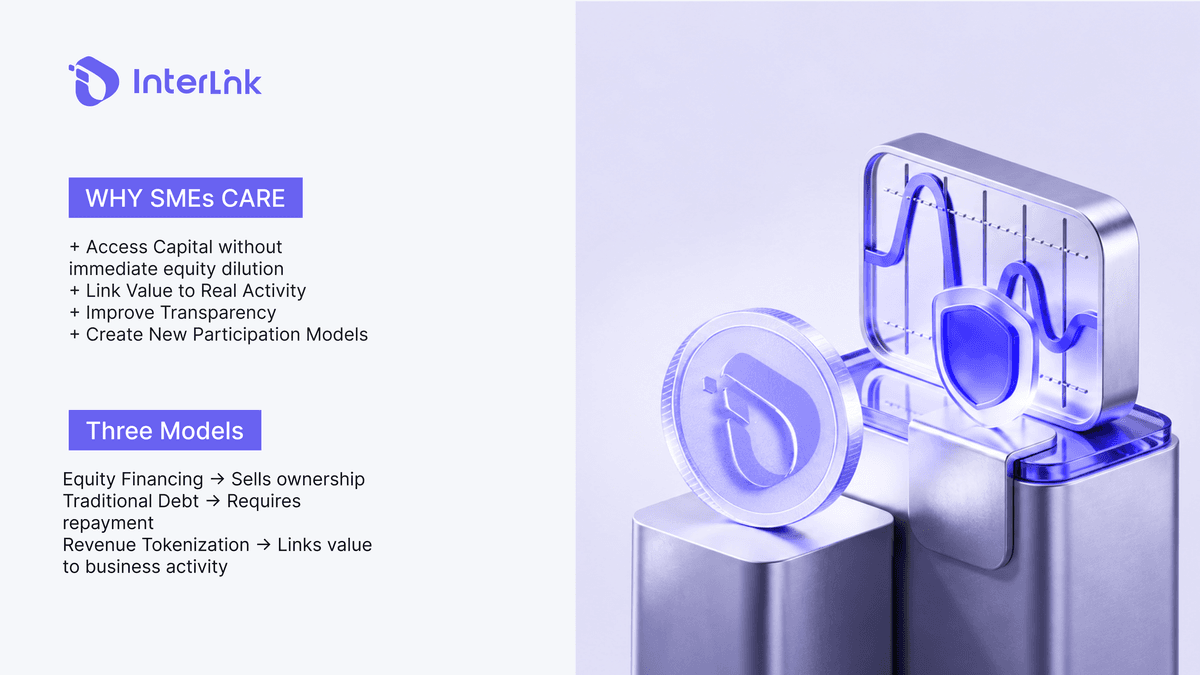
This differs from equity financing, which sells ownership and dilutes founders, and from traditional debt, which usually requires fixed repayments and credit approval.
Key Concept: Revenue Tokenization vs. Equity Dilution
Revenue tokenization focuses on economic activity and transaction flow. Equity financing sells ownership. The two models create different rights for participants.
Why SMEs Look for Revenue Tokenization
Many small and medium businesses need capital but face limits with banks, funds, or equity investors. Revenue tokenization is often discussed as an alternative path.
Common reasons include:
- Difficulty accessing bank credit
- Unwillingness to dilute equity too early
- Desire to link value to real sales or transaction activity rather than pure speculative valuation
- Need for a more transparent structure that partners and participants can verify
For SMEs, the appeal is practical: raise attention and capital around actual business operations, not only future promises. This model is particularly relevant for businesses that generate consistent transaction volume but lack the collateral or credit history that traditional lenders require.
How Business Revenue Tokenization Works Step by Step
The tokenization process involves several stages, from verifying the business to connecting real transactions with on-chain value. Each stage serves a specific purpose in the overall architecture.
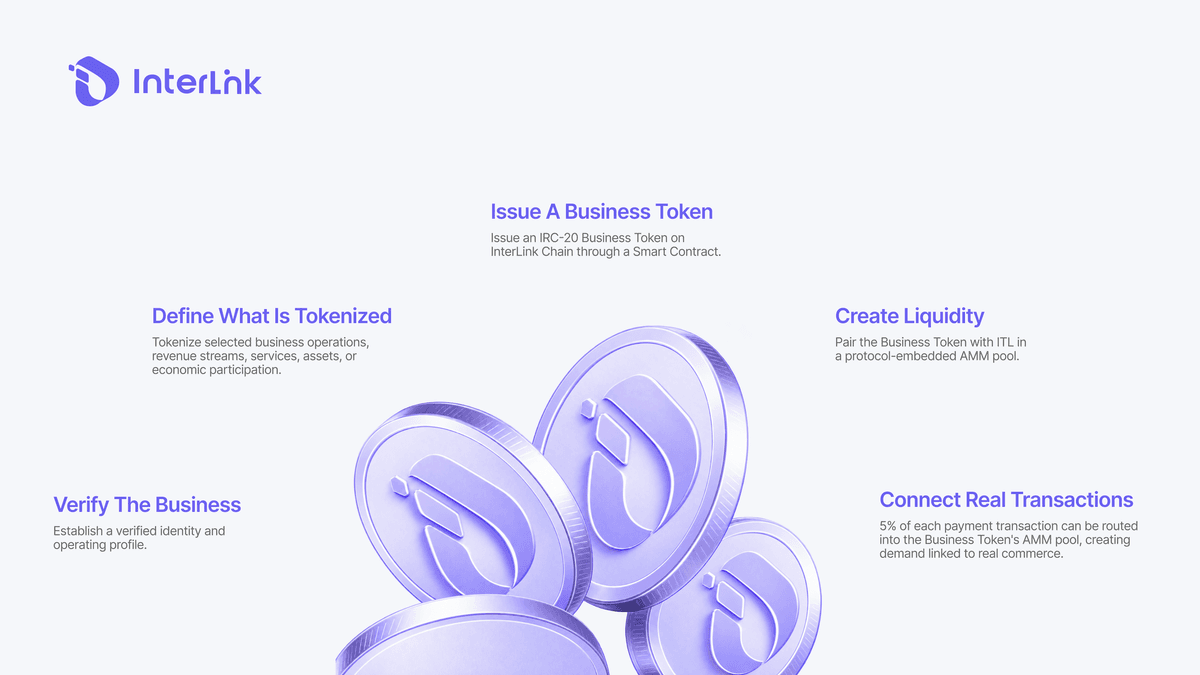
Step 1: Verify the business
A clear identity and operating profile help reduce fraud and build trust. Any individual or organization holding an InterLink ID can register as a payment point and integrate their business directly with InterLink's payment infrastructure. Up to 10,000 businesses and individuals can participate in this initial phase.
Step 2: Define what is being tokenized
Not every model means "cash revenue is paid out like a dividend." Many designs tokenize business activity or operations, with value support linked to real transactions. A business can tokenize specific parts of its operations revenue streams, assets, services, or economic participation rights into a Business Token.
Step 3: Issue a business token via smart contract
The business issues a Business Token (based on the IRC-20 standard) on InterLink Chain. The smart contract sets supply, transfer rules, and holder rights. This token represents the tokenized economic activity and becomes the on-chain asset that participants can trade.
Step 4: Create liquidity and settlement
In InterLink's model, each Business Token is paired with ITL in a protocol-embedded AMM pool. This creates on-chain liquidity from the start, meaning every Business Token has a ready market for trading immediately after issuance.
Step 5: Connect real transactions to on-chain value
When customers pay through the network's payment infrastructure, 5% of every transaction is automatically routed into the Business Token's AMM pool. This portion is used to buy the business's tokenized assets, creating sustained demand tied to actual commerce rather than speculation.
Key Concept: Transaction-Backed Value
In stronger designs, token value is supported by real payment flow - not only by market sentiment. The more genuine commercial activity a business generates, the stronger the on-chain support mechanism can become.
What Rights Do Business Token Holders Have?
Understanding the rights attached to a Business Token is essential before participating. Holding a Business Token creates a defined set of economic, governance, and liquidity rights.
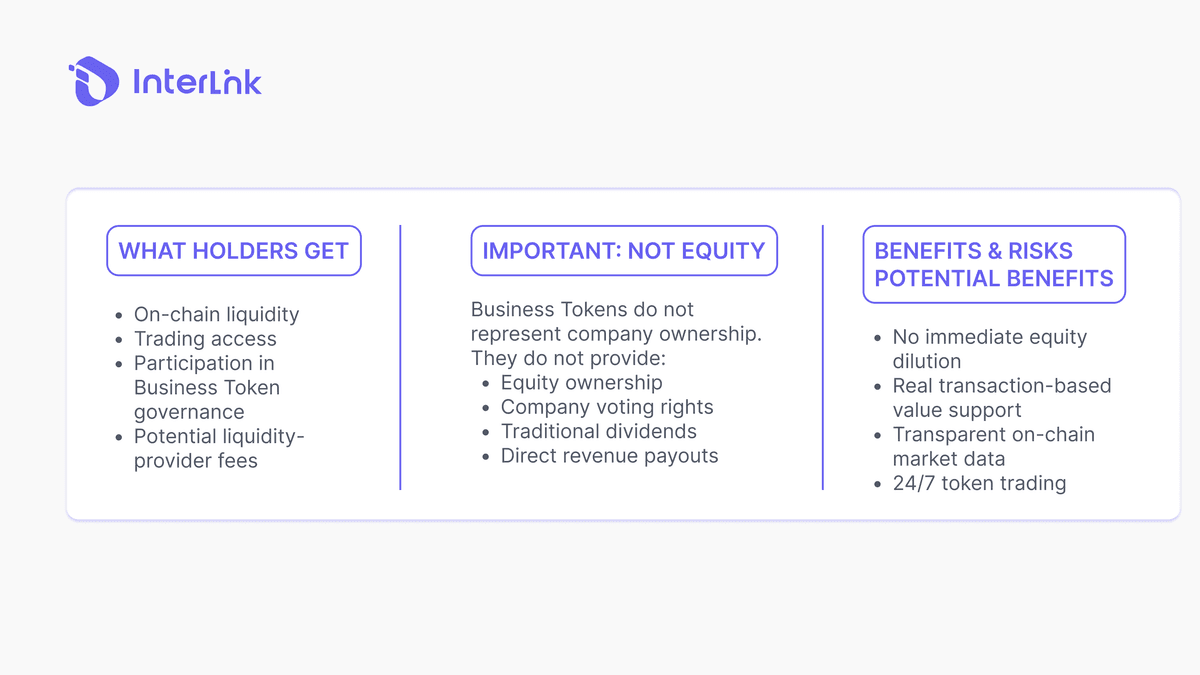
- Economic Rights: Holders benefit from continuous AMM buy-side demand, deepening liquidity, and optional fee yield for liquidity providers. As the business processes more transactions, more value is routed into the pool, creating sustained demand. However, Business Token holders do not receive traditional cash dividends or direct revenue payouts from the business.
- Governance Rights: Business Token holders can participate in decisions affecting their specific Business Token, such as supply parameter changes and AMM pool adjustments. This gives the holder community a voice in how their token evolves, without granting equity or control over the underlying business.
- Liquidity Rights: Business Tokens can be traded 24/7 on the AMM, providing continuous liquidity. Unlike traditional private business investments, Business Tokens can be bought and sold at any time. This creates a more flexible investment structure compared to locked equity positions.
Important Note: Business Tokens Are Not Equity
Holding a Business Token does not grant equity, ownership, voting rights in the company, profit-sharing, dividends, or any other form of financial return or governance rights in the issuing business. The economic effect is primarily expressed through on-chain demand, liquidity, and market mechanics tied to real transaction volume.
Smart Contracts and Automated Revenue Logic
Smart contracts are the technical layer that makes automated, transparent execution possible. They can encode issuance rules, transfer logic, and the conditions under which value is routed on-chain. This reduces dependence on manual intermediaries and gives participants a clearer audit trail. However, automation does not mean guaranteed profit. A smart contract only executes the rules it was given. Business performance, market liquidity, and external conditions still matter.
How InterLink Approaches This Model (IBTE & Transaction-Backed Protocol)
Under the Transaction-Backed Digital Assets Protocol, a verified business can issue a Business Token on InterLink Chain. The token is automatically paired with ITL in a protocol-embedded AMM. Real payments can route value into that market structure, creating buy pressure and deeper liquidity over time. IBTE is the marketplace layer for trading Business Tokens. ITL acts as settlement and reserve currency, while ITLG supports verified human participation in the wider ecosystem.
Important clarification: Business Token holders do not receive traditional cash dividends or direct revenue payouts. Value support comes from on-chain demand, liquidity, and market mechanics tied to real transaction volume.
Key Concept: Business Tokens Are Not Classic Dividends
In InterLink’s design, value support comes from transaction-backed market mechanics, not from traditional profit distribution. Understanding this difference is essential before participating.
Benefits and Risks of Revenue Tokenization
Like any capital-market design, revenue tokenization has both practical advantages and real risks. Understanding both sides helps businesses and participants make informed decisions.
Potential benefits
- Access to capital without immediate equity dilution
- Closer link between token value and real business activity
- Greater transparency through on-chain rules and market data
- New participation routes for users interested in operating businesses, not only speculative tokens
Key risks
- Real sales and transaction volume can rise or fall
- Smart contract and operational risks remain
- Early-stage markets may have limited liquidity
- Legal and regulatory frameworks differ by country and are still evolving
- No guaranteed return
Conclusion
Tokenizing business revenue connects real commercial activity with on-chain capital markets. For SMEs, it offers a path to capital based on operations and transaction flow potentially without immediate equity dilution. For participants, the key is understanding the exact rights behind the token.
InterLink's Transaction-Backed Digital Assets Protocol and IBTE show one concrete model: business tokens supported by real payments, settled in ITL, and traded on a dedicated marketplace. With 5% of every transaction routed into AMM pools, the model creates a direct link between commercial throughput and on-chain demand. Results still depend on business performance, adoption, and regulation.
Disclaimer: This guide from InterLink Labs is for educational purposes only and does not constitute financial, legal, or investment advice. Always conduct your own research before making decisions.

