


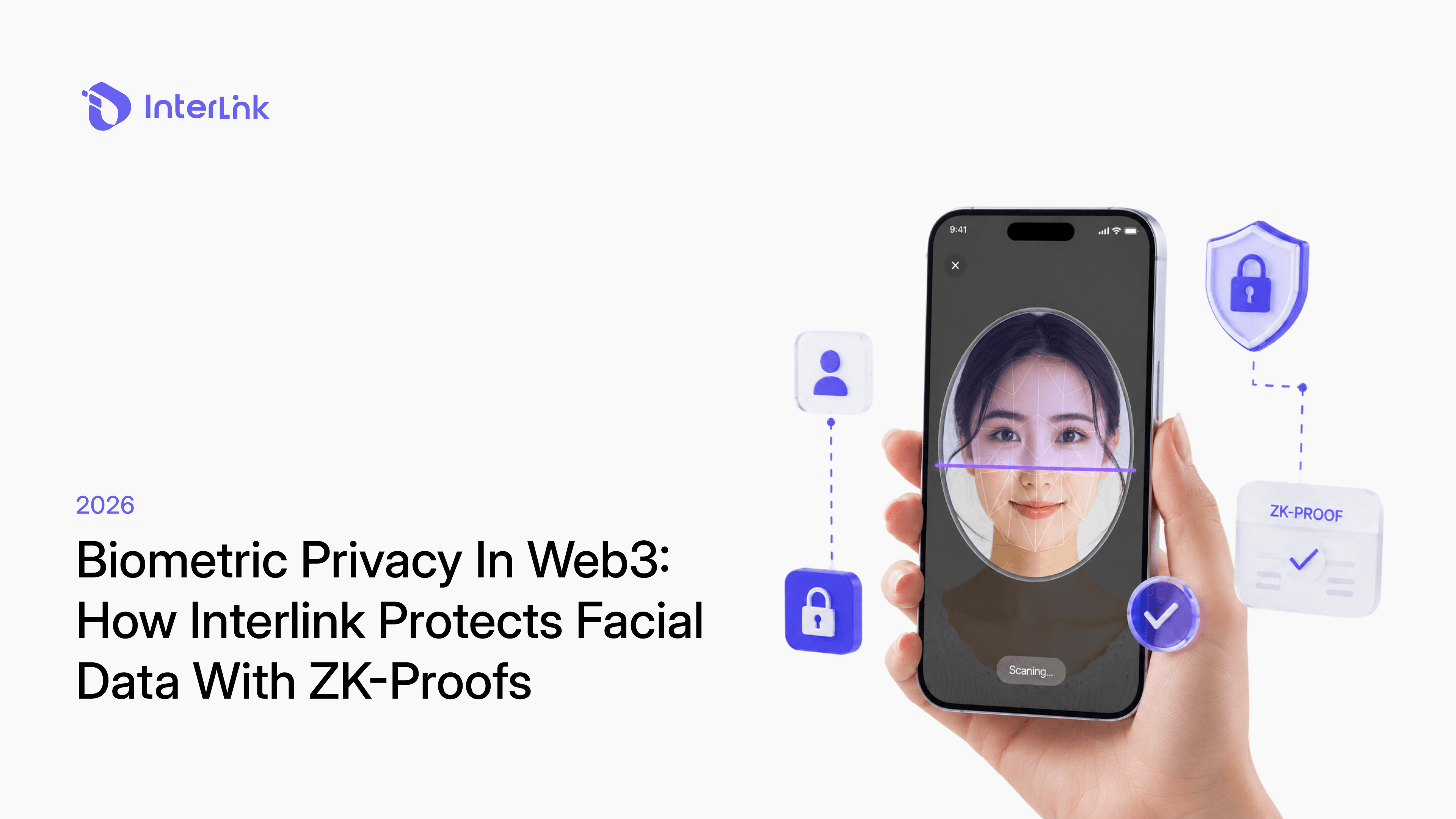
Biometric Privacy In Web3: How Interlink Protects Facial Data With ZK-Proofs (2026)
Aug 20, 2026
Technology
When you complete facial verification in a Web3 application, it is natural to wonder what happens to your biometric data. Questions like "Is my face being stored somewhere?" or "Could this data be leaked or sold?" are common and valid concerns.
This guide explains exactly how Interlink processes and protects facial data during verification. The system uses two main technologies: on-device processing and Zero-Knowledge Proofs (ZKP). These technologies work together to ensure that your biometric data remains private and under your control at all times.
How Interlink Protects Biometric Data During Verification
To understand the privacy model, it helps to look at what happens from the moment you scan your face. The entire process is designed to minimize data exposure and maximize security.
The Verification Process Happens Entirely on Your Phone
When you complete Proof of Personhood in the Interlink app, the entire process happens inside your phone's secure hardware. This is a fundamental difference from traditional systems that upload biometric data to central servers.
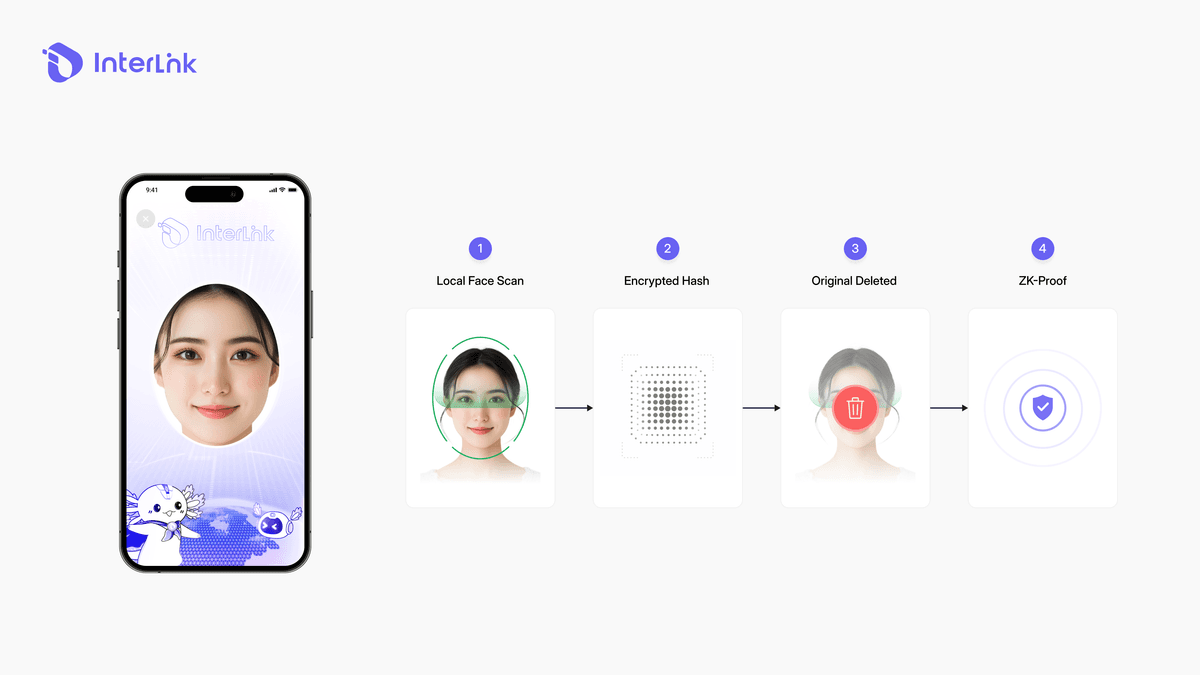
- Step 1 - Local facial scanning: Your face is scanned locally using the device's secure hardware. This is called Secure Enclave on iOS devices and TrustZone on Android devices. These are dedicated security chips designed to process sensitive data safely and in isolation from the main operating system.
- Step 2 - Instant conversion to encrypted hash: The raw image of your face is immediately converted into a mathematical representation. This is called an encrypted hash. At this point, the original photo or video file is deleted from the device. The hash cannot be reversed to reconstruct the original image.
- Step 3 - Original data deletion: The original photo or video is deleted at once and never leaves your device. There is no backup, no cloud storage, and no server upload. The deletion is immediate and permanent.
- Step 4 - Zero-Knowledge Proof creation: Only a cryptographic proof is created to confirm that you are a unique, living human. This proof does not contain any facial data. It only contains a mathematical confirmation that the verification was successful.
Key Concept: On-Device Processing vs. Centralized Cloud Storage
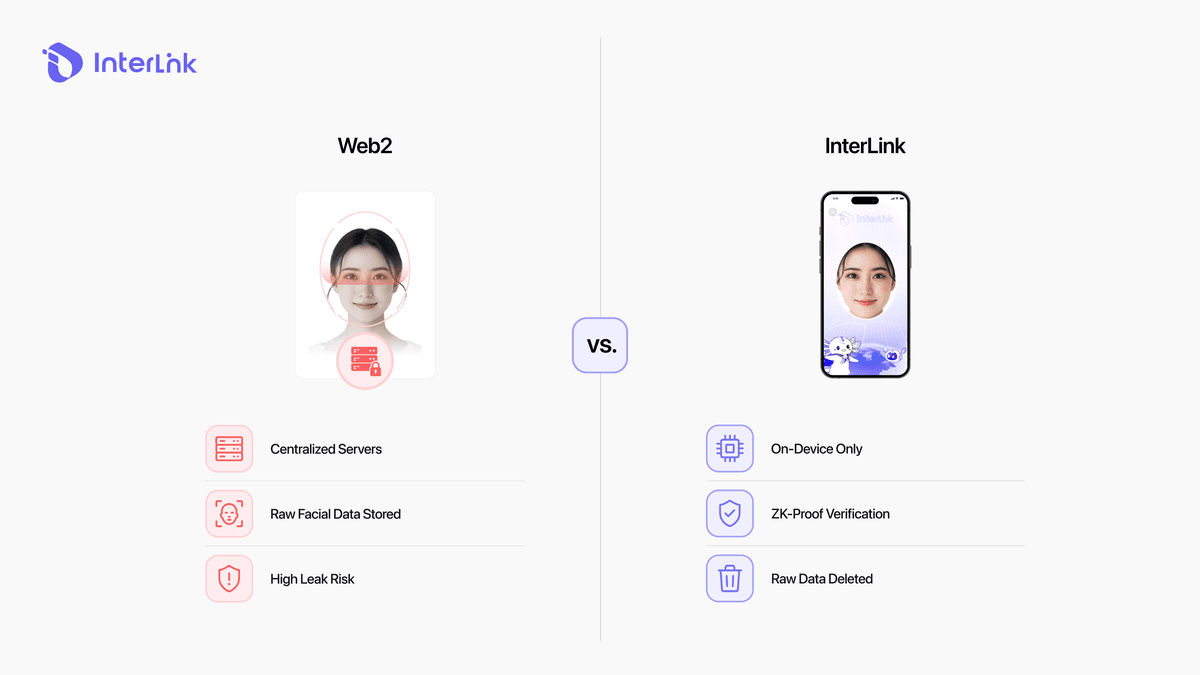
The fundamental difference is where the data is processed. In traditional Web2 systems, biometric data is often uploaded to centralized servers. This creates a single point of failure. If the server is breached, all facial data can be leaked.
Interlink takes a different approach. All biometric processing happens on your device. No company server, no cloud storage, and no risk of your photo being sold or leaked. Everything stays on your phone. This approach eliminates the need to trust a third party with your most sensitive data.
What Is Zero-Knowledge Proof (ZKP) in Interlink?
Zero-Knowledge Proof is a cryptographic method that allows one party to prove something to another party without revealing any additional information. It is a way to verify a claim without sharing the underlying data that supports that claim.
How ZKP Works in Interlink
According to Interlink's official whitepaper, Zero-Knowledge Proof allows the network to verify one precise statement:
"This is a unique, living human who has not previously registered."
The proof confirms three things:
You passed the liveness check (you are a real, living person).
Your biometric data creates a unique identity.
This identity has never been registered before.
What ZKP Does Not Reveal
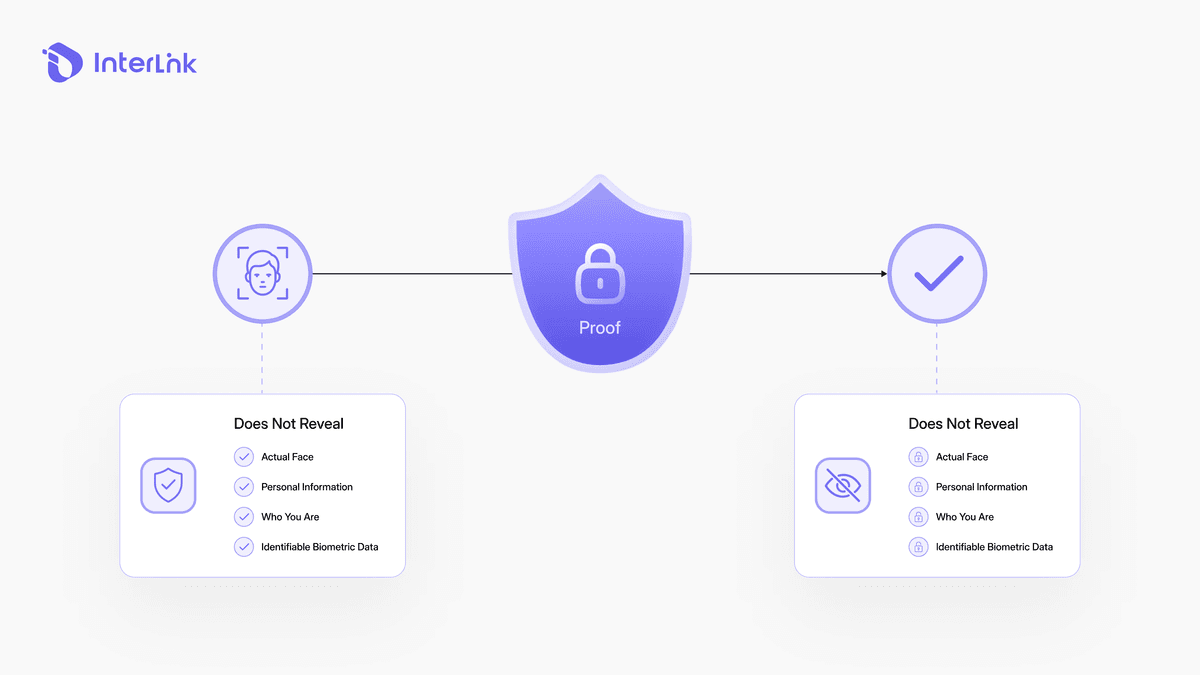
The proof does not reveal:
Your actual face
Any personal information
Who you are
Any identifiable biometric data
Only the mathematical proof is used. Your real face stays private on your device. The system verifies your uniqueness without ever seeing what you look like.
Key Concept: Privacy-Preserving Identity
ZKP enables a rare combination in digital identity: strong verification with complete privacy. You prove you are human. The system learns nothing else. This is the combination that most identity projects still cannot offer. It represents a significant advancement in how identity verification can be conducted in the digital age.
Why Proof of Personhood Requires ZK-Proofs
Proof of Personhood is the mechanism that ensures each user is a unique human being. But without ZK-Proofs, this would require storing biometric data centrally. This creates both privacy risks and security vulnerabilities.
The Problem with Centralized Storage
In the old Web2 world, facial data is often stored in centralized databases. One breach and millions of faces can be leaked or sold. This has happened many times with major companies. The consequences can be severe and long-lasting.
Even if a company has good intentions, centralized storage creates a tempting target for attackers. The data cannot be "un-leaked" once it has been compromised.
How Interlink Eliminates the Risk
Interlink flips the model completely:
No central database of faces exists.
No raw biometric data ever leaves your phone.
ZK-Proofs make surveillance-style data collection impossible.
Verification remains free for every real human.
The system does not need to store your face because it only needs to verify that you are unique. The ZKP provides this verification without the risks associated with data storage.
Comparison: Web2 vs. Interlink Privacy Model
Conclusion
Interlink proves that you can have strong Proof of Personhood and complete biometric privacy at the same time. Your face stays on your phone. Only a mathematical proof of uniqueness goes out. Verification is free. Mining is free. Your identity remains under your control.
This approach represents a departure from traditional identity verification methods. It combines the security of cryptographic proofs with the convenience of mobile-first design.
Disclaimer: This guide from InterLink Labs is for educational purposes only and does not constitute financial advice. Always conduct your own research before participating in any Web3 token ecosystem.
Related Article: Understand the economics behind your verified identity read the ITL and ITLG Token Guide in Cluster 9.

