

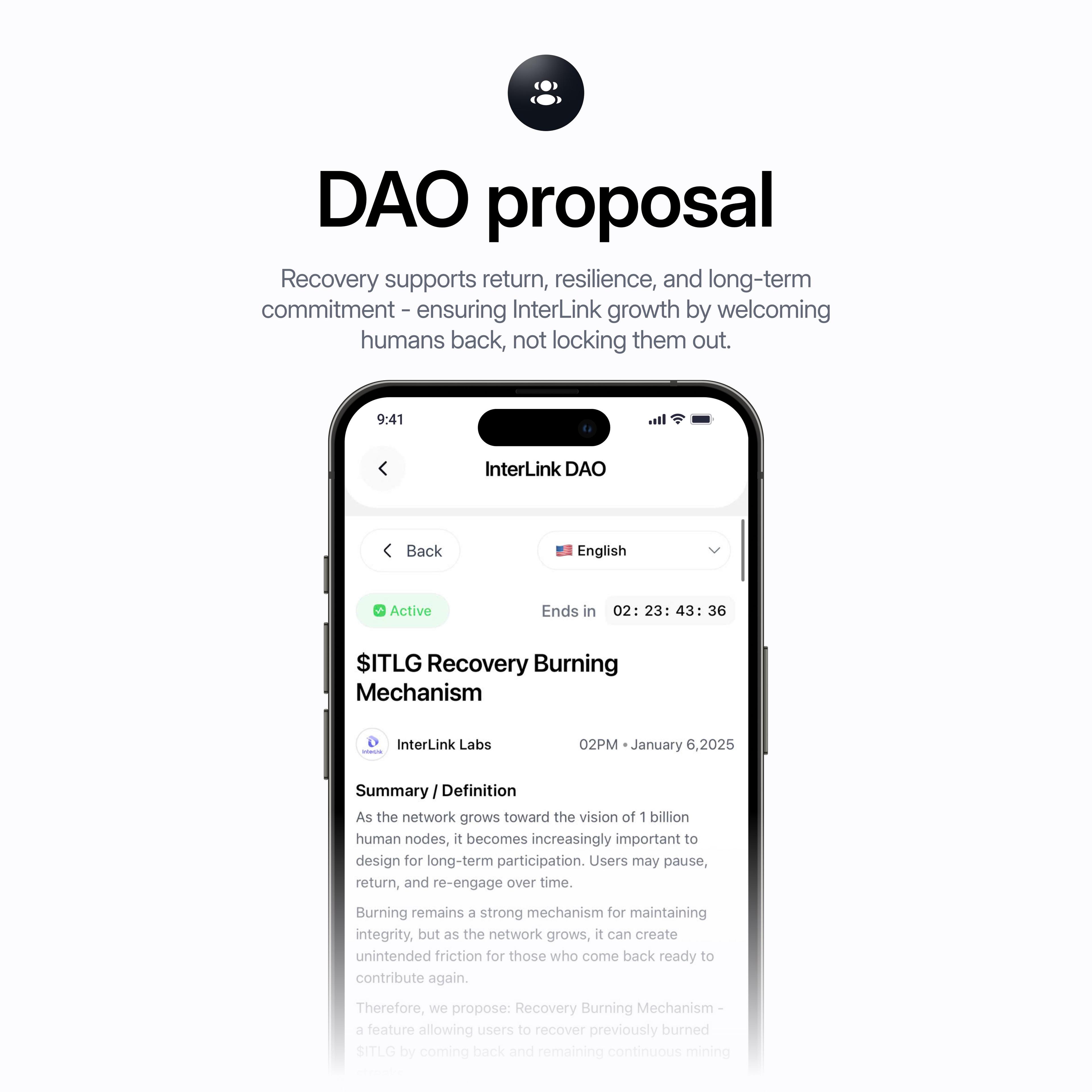
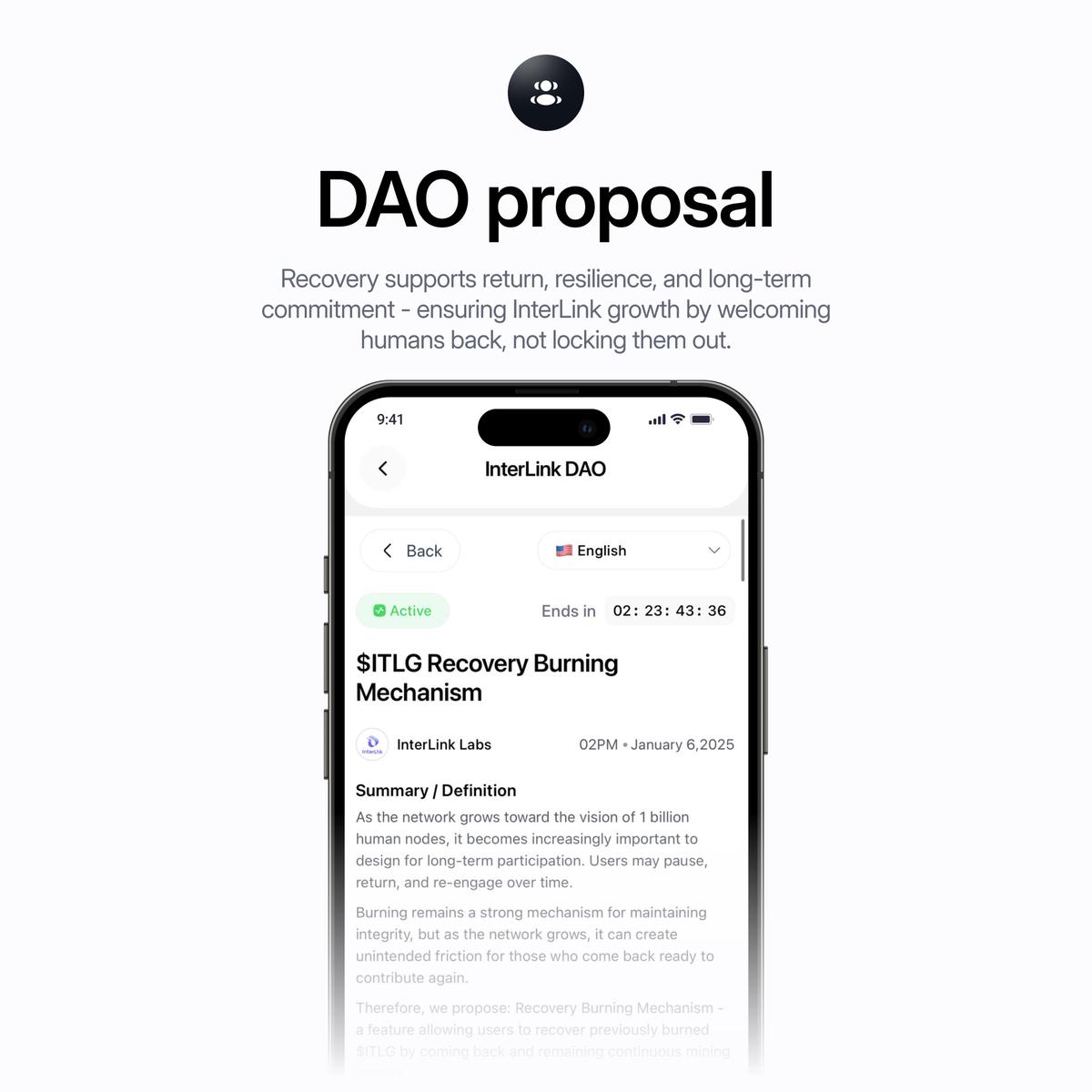
InterLink Network DAO Proposal 14: Introducing a $ITLG Recovery Burning Mechanism
Jan 08, 2026
Technology
Main takeaways
- The InterLink Network introduces a $ITLG recovery mechanism to balance discipline with long-term inclusivity.
- Recovery is earned through consistent activity, not shortcuts, preserving fairness across the network.
- Burning and recovery work together to protect scarcity while keeping the ecosystem open.
- The mechanism strengthens user retention, referral fairness, and long-term network scalability.
- This DAO proposal empowers the community to shape InterLink’s economic future.
Introduction
As the InterLink Network continues to scale globally, maintaining a healthy balance between discipline and inclusivity has become more important than ever. DAO Proposal 14 introduces a $ITLG recovery mechanism - an add-on system designed to complement the existing burning model. While burning protects the network by removing inactive nodes and limiting inflation, recovery creates a structured pathway for committed users to return through sustained activity.
This proposal reflects InterLink’s long-term vision: building a fair, scalable Human Network where real participation matters. Recovery does not weaken discipline - it reinforces it by rewarding consistency, protecting community builders, and ensuring the network remains open as it grows toward one billion verified users.
Proof of Concept - Why a $ITLG Recovery Mechanism Is Needed
As the InterLink Network scales, the burning system has been essential for maintaining discipline and network integrity. By removing inactive Human Nodes, it rewards long-term contributors, keeps activity high, creates scarcity, and eliminates bots. For active users, this reinforces fairness and commitment. However, it also introduces challenges. Users who step away due to real-life circumstances risk losing months of progress, creating psychological pressure. Over time, this can concentrate tokens among a small group of hyper-active users, raising barriers for returning participants and potentially limiting long-term network growth.
To address this, the $ITLG recovery mechanism is proposed as an additional layer - without changing the current burning model. This recovery framework allows users to regain burned allocations by maintaining continuous activity streaks. The longer a user stays active, the more recovery rights they earn. Once recovery is complete, referral rewards can also be restored, supporting community builders who drive network growth. This approach balances discipline with redemption, ensuring the InterLink Network remains open, scalable, and aligned with its vision of onboarding one billion real human participants while preserving trust and long-term sustainability.
How the $ITLG Recovery Mechanism works
Streak-Based Recovery Model
The $ITLG recovery mechanism within the InterLink Network is built around long-term commitment. Instead of instantly restoring burned tokens, users must earn recovery through consistent future activity. Every four consecutive mining sessions generate one recovery ticket, allowing users to restore their earliest burned cycle.
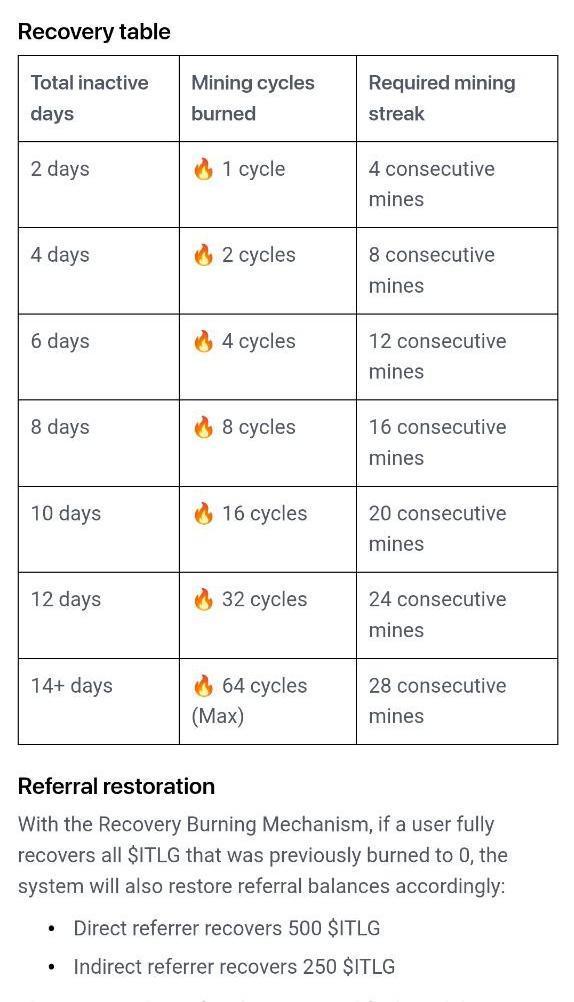
As users maintain longer streaks, they unlock higher recovery tiers:
- 4 sessions → recover 1 burned cycle
- 8 sessions → recover 2 burned cycles
- 12 sessions → recover 4 burned cycles
And so on, until all burned $ITLG is fully recovered. This structure ensures recovery is gradual, fair, and effort-based - rewarding discipline while still offering returning users a meaningful second chance.
Referral Recovery Mechanism
The recovery system also protects community builders and referrers. When a user fully recovers all previously burned $ITLG, the system automatically restores referral rewards - 500 $ITLG for the direct referrer (F1) and 250 $ITLG for the indirect referrer (F0). If a downline account (F2) was fully burned, rewards for both F1 and F0 were temporarily removed. Once F2 completes their recovery streaks, those referral rewards are restored proportionally. This ensures referrers are not permanently penalized, recovery benefits flow fairly across the referral network, and long-term community builders continue to be rewarded for their contributions.
Normal Mining Continues
The recovery mechanism does not replace normal mining. Daily mining rewards remain unchanged and continue as usual, while recovery progress runs in parallel and can only be earned through future activity. There are no shortcuts, manual exceptions, or special privileges. Recovery is achieved purely through real participation and consistent engagement, reinforcing InterLink Network’s core values of fairness, discipline, and long-term sustainability.
Common Misconceptions About the $ITLG Recovery Burning Mechanism
“Recovery contradicts burning”
This is a common misunderstanding. The $ITLG recovery mechanism is not designed to replace or weaken burning - it works alongside it. Burning remains fully intact as the core discipline tool of the InterLink Network, protecting committed users, reducing bots, and maintaining scarcity. Recovery simply acts as an add-on layer that allows genuinely returning users to re-enter the ecosystem through sustained effort. Scarcity alone has no value if the network cannot grow. By combining burning and recovery, InterLink balances discipline with long-term scalability - protecting committed users while keeping the network open and human-centered.
“Recovered users are treated the same as loyal users”
This is not true. Recovery is partial by design. At least 1% of burned $ITLG remains permanently burned in every cycle, meaning inactivity always carries a lasting cost. In addition, users who were burned are ranked behind consistently committed users in future verification and trust systems. Those who never broke consistency always retain priority, while returning users must prove themselves again through sustained activity. There are no shortcuts, no privileges, and no special treatment - commitment always comes first.
“The recovery mechanism delays token listing”
This view misses InterLink’s core strategy. While InterLink could technically list now, doing so before our own blockchain is fully built would not benefit users - there would be no fair distribution mechanism and limited real token circulation. InterLink is intentionally prioritizing blockchain infrastructure first to ensure tokens are distributed through verified human activity, not speculation. The recovery mechanism supports this long-term vision by preserving user participation and ecosystem stability during this build phase. Listing will happen when the network is ready - fairly, sustainably, and in the community’s best interest.
Long-Term Value of the $ITLG Recovery Mechanism for InterLink Network Users
The $ITLG recovery mechanism strengthens the InterLink Network by giving users a second chance - without lowering standards. Short-term inactivity no longer permanently erases long-term contribution, but recovery is only possible through consistent mining streaks. This ensures discipline remains intact while allowing committed users to re-enter the ecosystem through real effort, not shortcuts.
At a network level, recovery keeps the InterLink Network open and scalable, supporting its vision of one billion Human Nodes. It prevents the system from becoming closed over time while protecting token scarcity and fair distribution. Instead of inflation, opportunity is redistributed through behavior - reducing extreme concentration and building a more sustainable, long-term $ITLG economy.
Conclusion
DAO Proposal 14 marks an important step in the evolution of the InterLink Network. The introduction of the $ITLG recovery mechanism shows a clear commitment to building a system that is not only disciplined, but also humane. Burning protects the network from inactivity and bots, while recovery ensures that long-term contributors who temporarily step away are not permanently excluded. Together, these mechanisms create a balanced economic model - one that rewards consistency, protects scarcity, and keeps the network open as it scales toward one billion real Human Nodes.
This proposal is not just about token mechanics - it is about defining the values of the InterLink Network: fairness, accountability, and long-term sustainability. Recovery is earned, not given. It requires real effort, real participation, and real commitment - exactly what a human-first network should stand for.
Now, the future direction of the InterLink Network is in your hands.
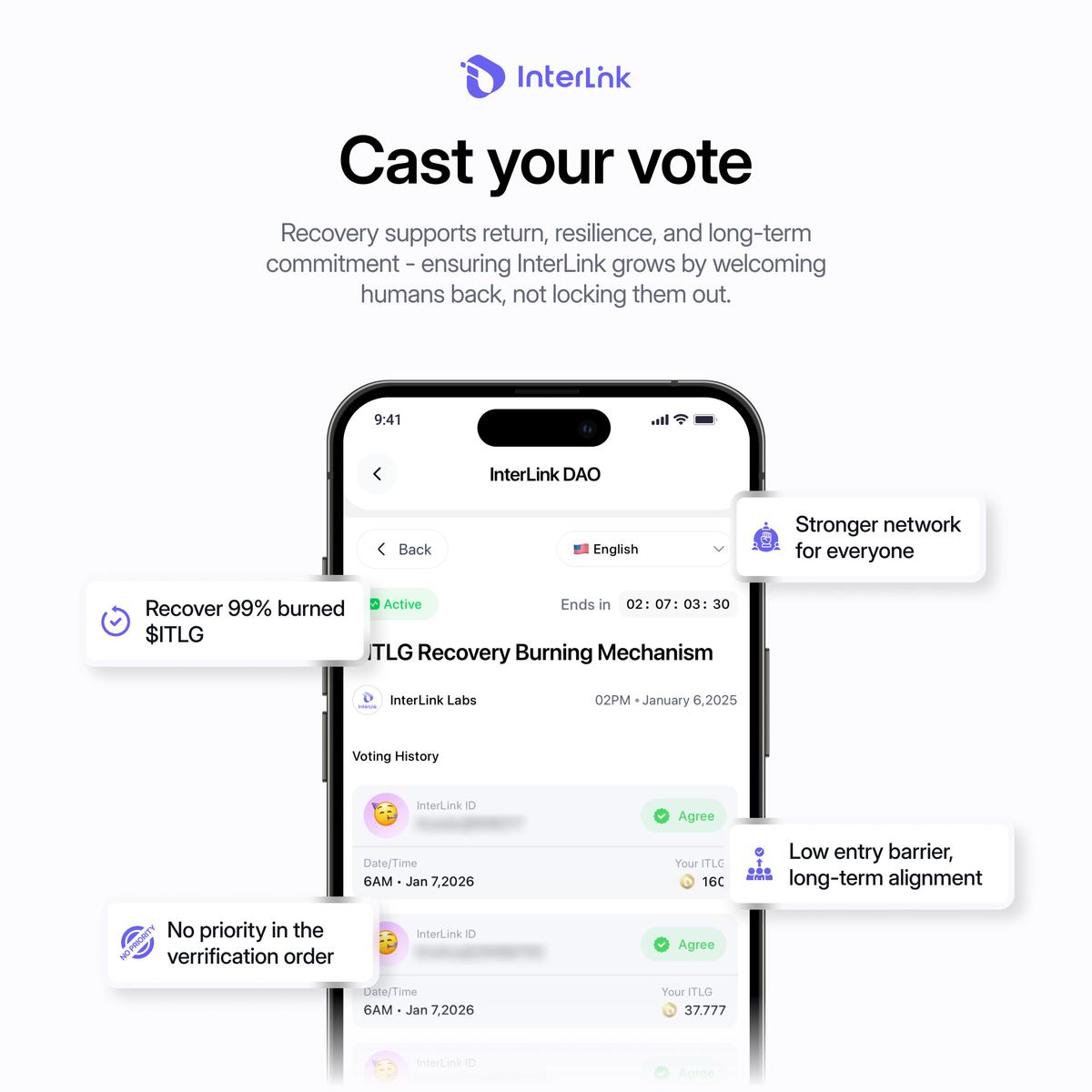
Join the discussion and cast your vote inside the InterLink Mini App.
Your decision today will help shape the long-term health of the ecosystem.
Follow our social for latest updates:

