




Best Crypto Prediction Markets 2026: How They Work
Oct 29, 2026
Partners
Crypto prediction markets have transitioned from niche Decentralized Finance (DeFi) experiments into a thriving multi-billion-dollar global asset class. By early 2026, leading prediction venues recorded unprecedented activity, with monthly trading volumes climbing past $20 billion across political, financial, and crypto-native event contracts.
Digital asset contracts continue to serve as the single largest onboarding channel for retail traders entering the decentralized forecasting landscape. This article explores the core mechanics of prediction platforms, reviews top market venues in 2026, and details how native blockchain ecosystems like InterLink are pioneering fully on-chain settlement models.
What Are Crypto Prediction Markets?
Crypto prediction markets are exchange protocols that allow users to trade contracts based on the outcome of future events. Prices directly reflect collective probability estimates, adjusting dynamically as new information becomes available to market participants. Understanding these structural fundamentals is crucial for evaluating modern decentralized forecasting networks.
Definition and Core Concept
Prediction markets utilize binary option contracts where outcomes resolve to either YES or NO. Shares trade between $0.00 and $1.00, representing the market's implied probability of an event occurring. Winning contracts automatically pay out $1.00 per share via automated smart contract execution upon resolution.
How Prediction Markets Work
Every market originates with a clearly defined, verifiable resolution question. Traders can lock in profits by exiting positions before event completion or hold positions until full settlement. Automated market makers and order books maintain continuous liquidity for active trading strategies throughout the contract lifecycle.
The Role of Blockchain and Oracles
Blockchain infrastructure eliminates counterparty risk by holding collateral in transparent escrow smart contracts. Decentralized oracle networks bridge external real-world outcomes onto the blockchain for objective contract verification. Leading implementations incorporate optimistic dispute windows, juror staking mechanisms, and cryptographic price feeds to maintain data integrity.
Best Crypto Prediction Markets in 2026
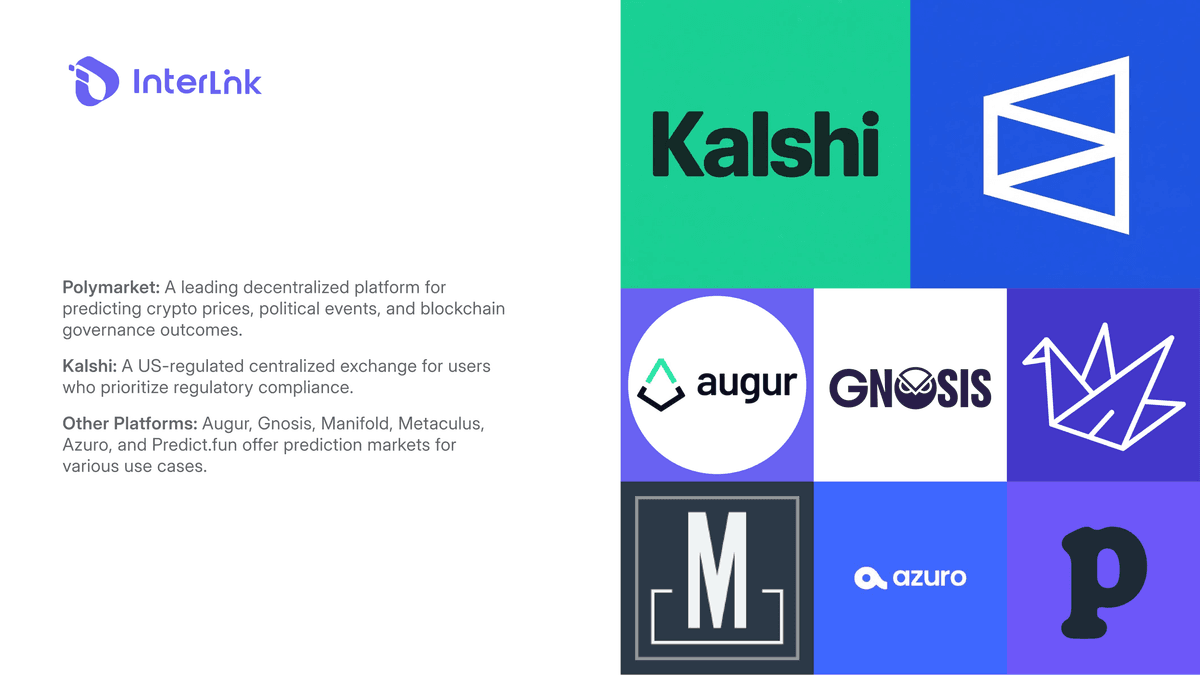
The forecasting sector features distinct choices ranging from permissionless decentralized protocols to regulated institutions. Traders select platforms based on geographical accessibility, liquidity depths, asset settlement methods, and legal protections. The top market venues in 2026 include:
- Polymarket (The Dominant Decentralized Platform): Operating on Polygon with USDC settlement, Polymarket leads global volume through non-custodial crypto trading across macro and digital asset contracts.
- Kalshi (The Regulated US Alternative): Functions as a CFTC-regulated exchange providing compliant USD fiat clearing and institutional access for US domestic traders.
- Key Platform Differences: Polymarket prioritizes global web3 accessibility and privacy, whereas Kalshi provides legal protections and direct banking integration.
BitFlip: InterLink's Fully On-Chain Prediction Market
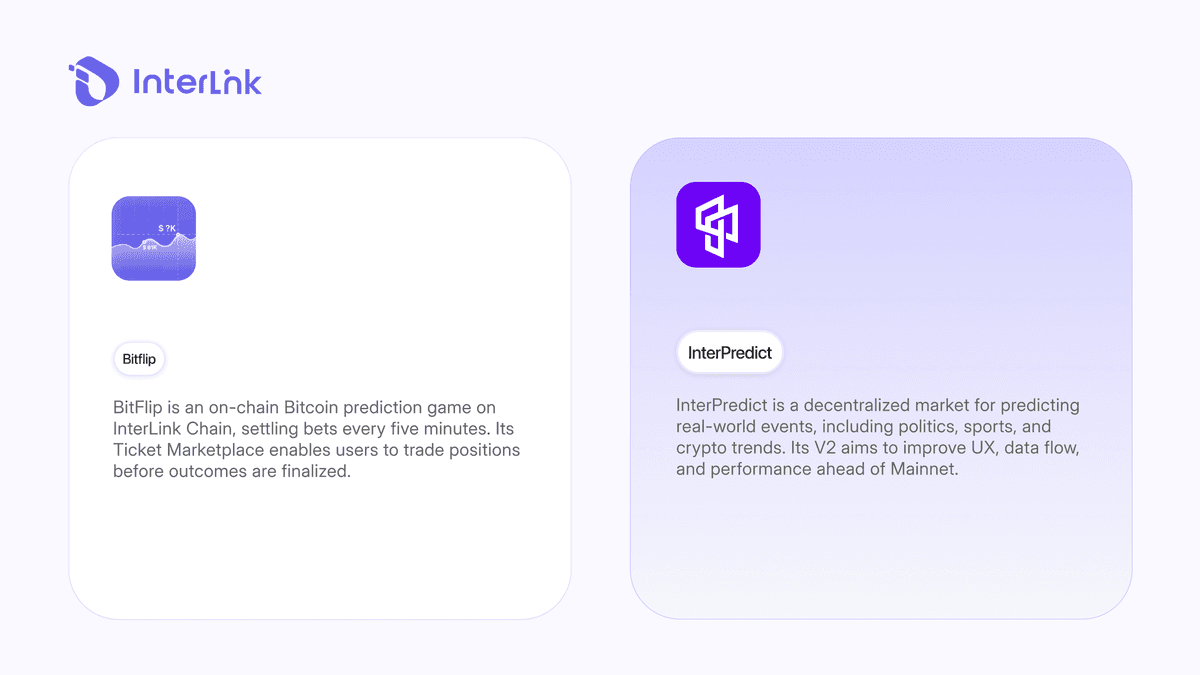
BitFlip brings a high-speed prediction game model directly to the InterLink blockchain network. Operating on 5-minute settlement rounds, positions are processed and locked entirely on-chain without relying on off-chain databases. This architecture ensures complete transparency, rapid turnover, and verifiable fairness for high-frequency Bitcoin price speculation.
How BitFlip Works
BitFlip executes continuous short-interval prediction cycles on the InterLink network. Automated price feeds establish strike values at the start of each five-minute window. At settlement, smart contracts instantly credit payouts directly into winner wallet addresses.
The Ticket Marketplace and Secondary Trading
BitFlip introduces a peer-to-peer Ticket Marketplace allowing traders to buy or sell position tickets mid-round. Secondary trading windows open three minutes after price locks, providing hedging opportunities. Traders can secure early profits or mitigate potential losses prior to final round resolution.
Ecosystem Role
BitFlip serves as a high-throughput stress test for InterLink's core protocol architecture. It works alongside ITL Vault, INS naming services, and LinkersMap to enhance network activity. Future updates will introduce jackpot pools and order book mechanics to expand $ITL utility.
InterPredict: InterLink's Event Prediction Market
InterPredict expands forecasting capabilities across politics, culture, sports, and macro trends. It provides an intuitive interface backed by native InterLink smart contract infrastructure. This decentralized application plays a major role in expanding real-world utility across the broader ecosystem.
- What Is InterPredict?: A decentralized event market where users buy YES/NO outcome shares settled transparently on the InterLink blockchain.
- Development Status & V2 Upgrades: InterPredict V2 introduces upgraded backend architecture, refined user interfaces, and faster oracle feeds following beta testing.
- Ecosystem Integration: Integrates with InterLink's identity and DeFi suite to drive organic utility and engagement for the $ITL token.
Market Trends and Growth in 2026
The prediction market landscape has recorded remarkable growth throughout 2026. Surging volume is driven largely by retail participation, expanding contract diversity, and seamless crypto payment rails. Key trends defining the sector's expansion include:
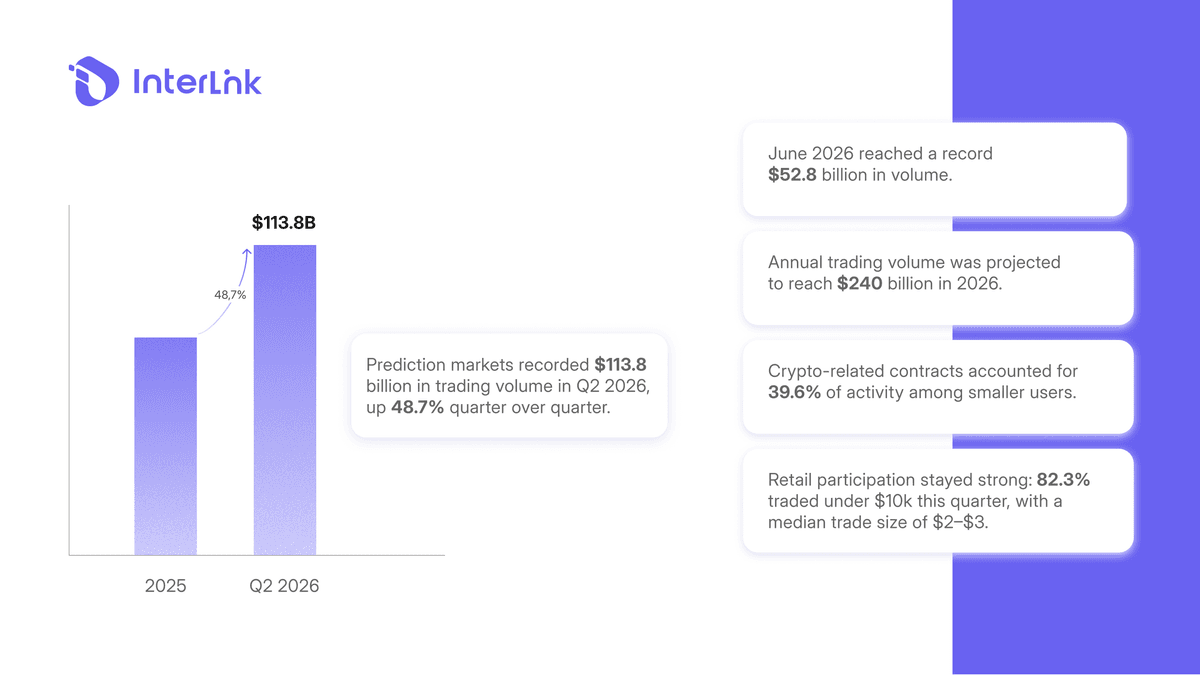
- Record-Breaking Volume: Prediction protocols processed over $100 billion quarterly in mid-2026, signaling strong mainstream adoption across retail demographics.
- Crypto as the Dominant Gateway: Digital asset price contracts accounted for nearly 40% of activity, serving as the primary onboarding funnel for Web3 users.
- Retail Participation Dominance: Over 80% of active users engage with modest position sizes under $10,000, creating robust recurring liquidity.
Decentralized vs. Centralized Prediction Markets
The prediction sector is divided between decentralized smart contract protocols and regulated centralized entities. Each model offers distinct trade-offs between user custody, regulatory compliance, and operational efficiency. Assessing these core structural differences helps users choose the optimal trading venue.
Key Differences
Decentralized protocols prioritize non-custodial trading, global access, and censorship resistance. Conversely, centralized platforms offer traditional legal frameworks, fiat currency clearing, and oversight by financial regulatory authorities. Traders evaluate these trade-offs based on personal location, compliance requirements, and custodial preferences.
The Oracle Problem and Dispute Resolution
Reliable data resolution remains essential for decentralized contract settlement integrity. Platforms combine optimistic bonding models, decentralised juror arbitration, and high-frequency oracle feeds to verify real-world outcomes. These resolution systems protect participants against data manipulation and contract disputes.
What This Means for Users
Web3 native traders often prefer non-custodial decentralized markets for privacy and self-sovereignty. Simultaneously, networks like InterLink integrate Proof of Personhood identity solutions to maintain Sybil resistance alongside decentralized execution. This hybrid approach delivers both security and accessibility across decentralized market products.
Conclusion
Crypto prediction markets have established themselves as vital decentralized infrastructure in 2026. Industry leaders like Polymarket, Kalshi, and InterLink's BitFlip highlight the diverse mechanics driving market adoption. As trading volumes expand, on-chain forecasting protocols will remain key drivers of Web3 innovation and user engagement.
InterLink's growing dApp ecosystem demonstrates how high-speed on-chain prediction models can integrate seamlessly into broader decentralized utility networks.
Disclaimer: This content is for informational purposes only and does not constitute financial or investment advice. InterLink Labs makes no guarantees regarding market performance or future outcomes. Readers should conduct their own research and assess the risks before participating in cryptocurrency or prediction market activities.

