



How Does Proof of Personhood Work? Biometric Privacy & Web3 Security
Aug 13, 2026
Our journey
Does InterLink’s Proof of Personhood capture, store, or upload your real face photo? According to the project’s design, no. The system is built to verify that you are a unique living human through on-device processing and cryptographic proofs, without retaining or transmitting the original biometric images to central servers.
What is a Sybil Attack and why does it matter?
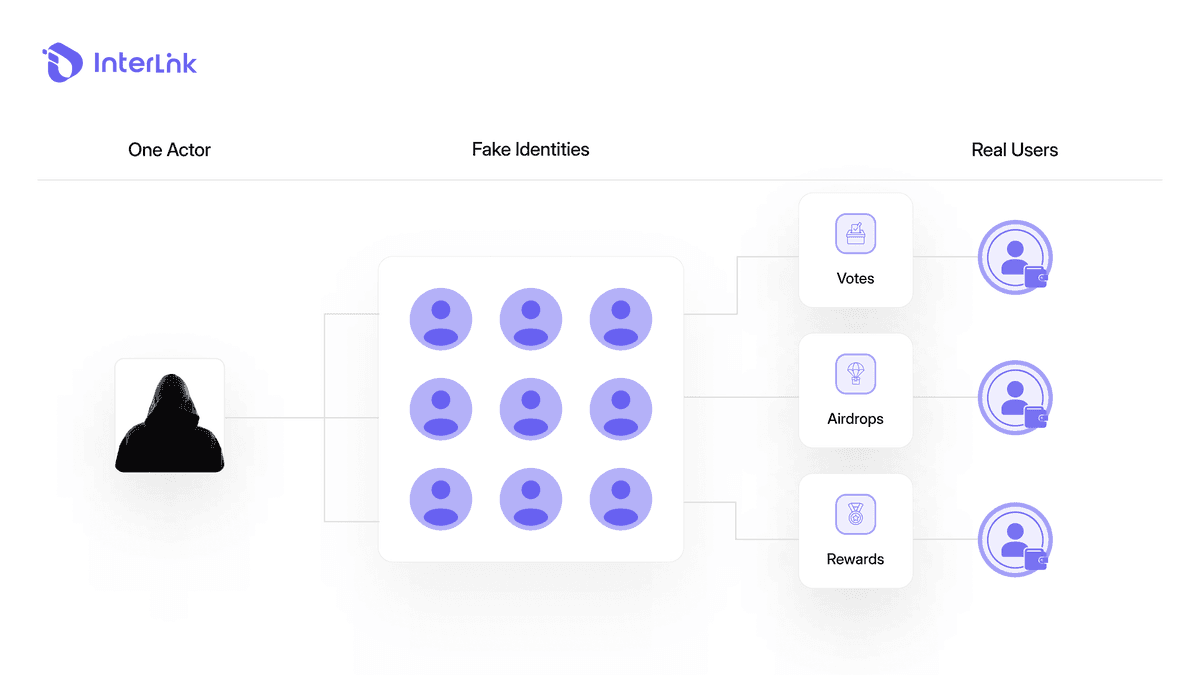
A Sybil attack occurs when one actor creates many fake identities to gain unfair influence-manipulating votes, claiming multiple airdrops, or capturing rewards intended for real users. In Web3, where wallets are cheap and anonymous, Sybil resistance has become one of the most important unsolved challenges.
PoP systems aim to raise the cost of such attacks by requiring each participant to prove they are a distinct living person. In Interlink’s model, each verified individual becomes a Human Node. Participation and reward rates are linked to identity verification status and ongoing activity rather than device computing power.
Key Concept: A Sybil attack happens when one actor creates many fake identities to gain unfair influence-manipulating votes, claiming multiple airdrops, or capturing rewards intended for real users.
How does Interlink aim to verify unique human identity without collecting raw data?
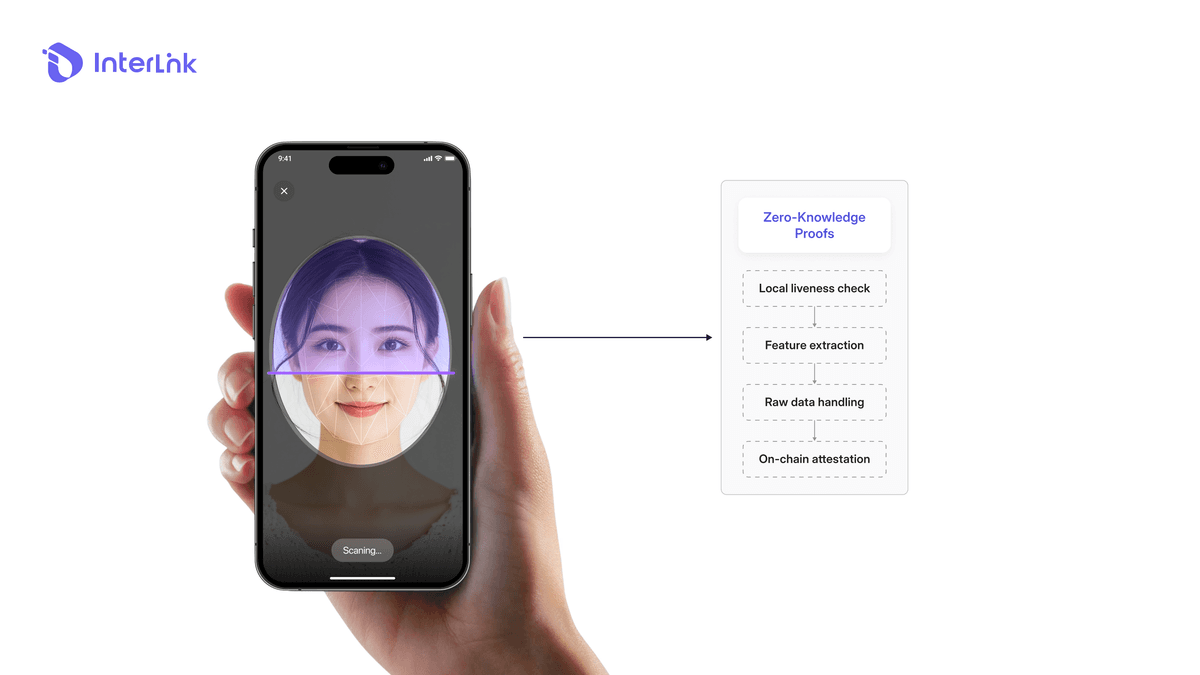
Interlink’s verification protocol is engineered with a privacy-first architecture. When you perform a facial verification scan in the app, the system follows a strict, decentralized zero-knowledge flow:
Local liveness check: The front camera performs an on-device test to confirm a live person is present (not a photo or pre-recorded video).
Feature extraction: Abstract facial geometry data is converted into a mathematical representation (hash).
Raw data handling: Original images and video frames are intended to be discarded from local memory after processing and not sent to servers.
On-chain attestation: Only an encrypted, non-reversible cryptographic proof is used for network verification.
Key Concept: Zero-Knowledge Proofs allow one party to prove that a statement is true (“I am a unique living human”) without revealing the underlying private information (the actual face or photo) used to generate that proof.
The role of Zero-Knowledge Proofs (ZKP)
Zero-Knowledge Proofs allow one party to prove that a statement is true “I am a unique living human” without revealing the underlying private information used to generate that proof. In Interlink’s design, ZKPs (combined with techniques such as hashing and commitments) enable the network to confirm uniqueness and liveness while limiting exposure of biometric data.
This approach is intended to reduce the privacy risks associated with centralized biometric databases. The actual strength of these guarantees depends on the quality of the implementation, independent audits, and real-world usage.
PoP vs. Alternative consensus models: Key advantages
To understand how does proof of personhood work in practice, it helps to compare Interlink's PoP approach against both traditional consensus models and physical hardware-dependent identity projects:
Interlink positions its model as fully software-based. The project has stated that its Human-AI verification model achieved a #51 ranking on a U.S. NIST FRTE benchmark. This ranking comes from Interlink’s own communications and refers to face-recognition performance metrics. Independent verification on public NIST leaderboards is recommended.
PoP Verification vs. Traditional KYC: What is the difference?
Many users confuse Proof of Personhood with traditional Know Your Customer (KYC) identity checks. While both verify credentials, their architectures and privacy philosophies are fundamentally opposite.
The two systems serve different goals. KYC establishes legal identity for regulatory purposes. PoP focuses on proving uniqueness and humanness while aiming to minimize exposure of personal data.
Project background and related claims
Interlink’s identity infrastructure is presented as more developed than typical early-stage crypto projects. Key points based on publicly available information include:
Participation in the Google for Startups program (incubator support, including cloud credits and mentorship) beginning around June 2025.
Media appearances, including content filmed in partnership with programs associated with the New York Stock Exchange. These represent media exposure rather than formal NYSE recognition or listing.
Self-reported user figures (previously cited in the millions) and statements about institutional interest in $ITLG. These figures come from project disclosures and should be treated as such.
As with any early-stage project, users should review official documentation, the privacy policy, and any available independent audits rather than relying solely on marketing materials.
Why is Proof of Personhood essential for AI and Crypto UBI?
As AI agents increasingly automate online activity, the ability to distinguish human participation from machine activity becomes foundational infrastructure. PoP can support:
- Fairer distribution of rewards or future UBI-style mechanisms by raising the cost of bot farming.
- More reliable governance and voting systems.
- Verified human layers that can interact with real-world asset (RWA) tokenization and payment features.
Interlink connects this identity layer to a dual-token model in which $ITLG functions as a pre-TGE contribution score intended to convert into $ITL. As with any early-stage project, the long-term value of such tokens depends on execution, adoption, tokenomics, and market conditions.
Summary
Proof of Personhood tries to solve a real Web3 problem-Sybil resistance-while using cryptographic techniques (including Zero-Knowledge approaches) to limit exposure of raw biometric data. Interlink’s implementation is designed around on-device processing and smartphone cameras rather than specialized hardware.
As with any early-stage project, the actual privacy guarantees, security, and long-term effectiveness depend on the quality of the code, independent audits, and real-world usage. Users should review the official documentation and privacy policy directly.
Disclaimer: This guide is for educational and informational purposes only and does not constitute financial or investment advice. Information about InterLink Labs and its Web3 token ecosystem is provided for general reference. Always conduct your own research before making any investment or participation decisions..
Ready to secure your Web3 Identity? Lean how to earn and withdraw ITLG Tokens in 2026

