


InterLink Tokenomics 2026: Complete Guide To ITL & ITLG Token Distribution
Sep 15, 2026
Our journey
What is InterLink tokenomics? It is the economic framework behind InterLink’s dual-token ecosystem, designed around verified human participation, sustainable token distribution, and long-term network utility. Through mechanisms such as token burns and progressive halvings, InterLink aims to manage supply growth while giving the community a central role in the ecosystem. Users can participate through the free mining app, contributing to the Human Node network while earning ITLG through eligible activities. This guide provides a clear overview of InterLink tokenomics based on information from the official InterLink Foundation whitepaper.
What is tokenomics?
Tokenomics is the economic design of a cryptocurrency or token. It covers how tokens are created, distributed, used, and managed over time - including total supply, allocation, incentives, inflation or deflation mechanisms, and utility. A well-designed tokenomics model aligns the interests of users, builders, and the network itself, encouraging long-term participation instead of short-term speculation.
Key Concept: Tokenomics
Tokenomics is the economic framework of a token - covering supply, demand, distribution, utility, and the rules that govern how value flows through the ecosystem.
InterLink Tokenomics at a Glance
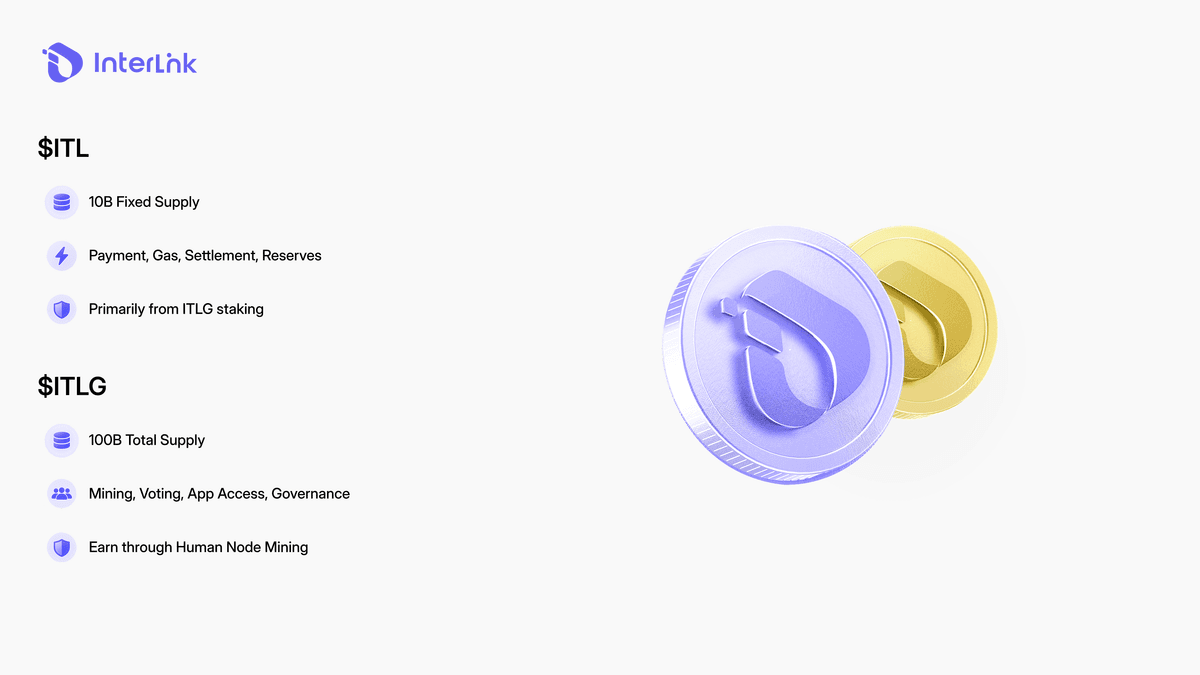
InterLink uses a dual-token model with clearly separated roles:
This separation allows ITLG to focus on community participation and governance, while ITL serves as the universal settlement and reserve asset of the network.
How are ITL and ITLG distributed?
InterLink’s distribution follows a simple rule: tokens first reach the verified humans who actively participate. Both ITLG and ITL follow this principle, with clear priorities and no private preferential access.
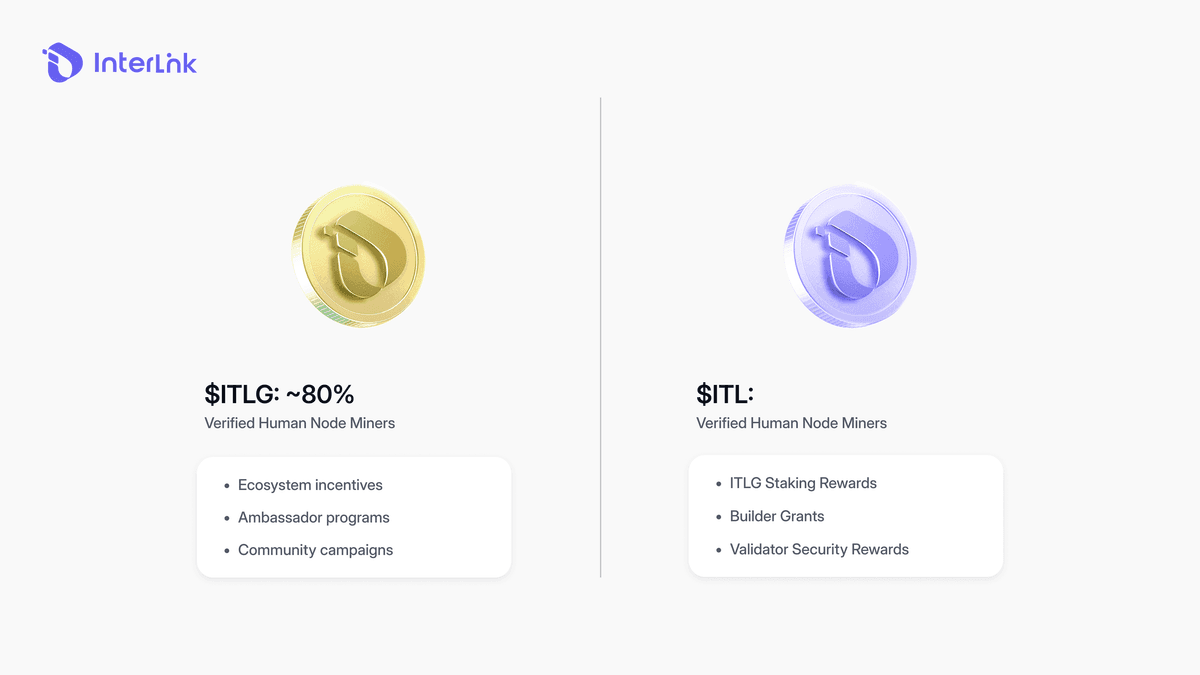
ITLG Distribution
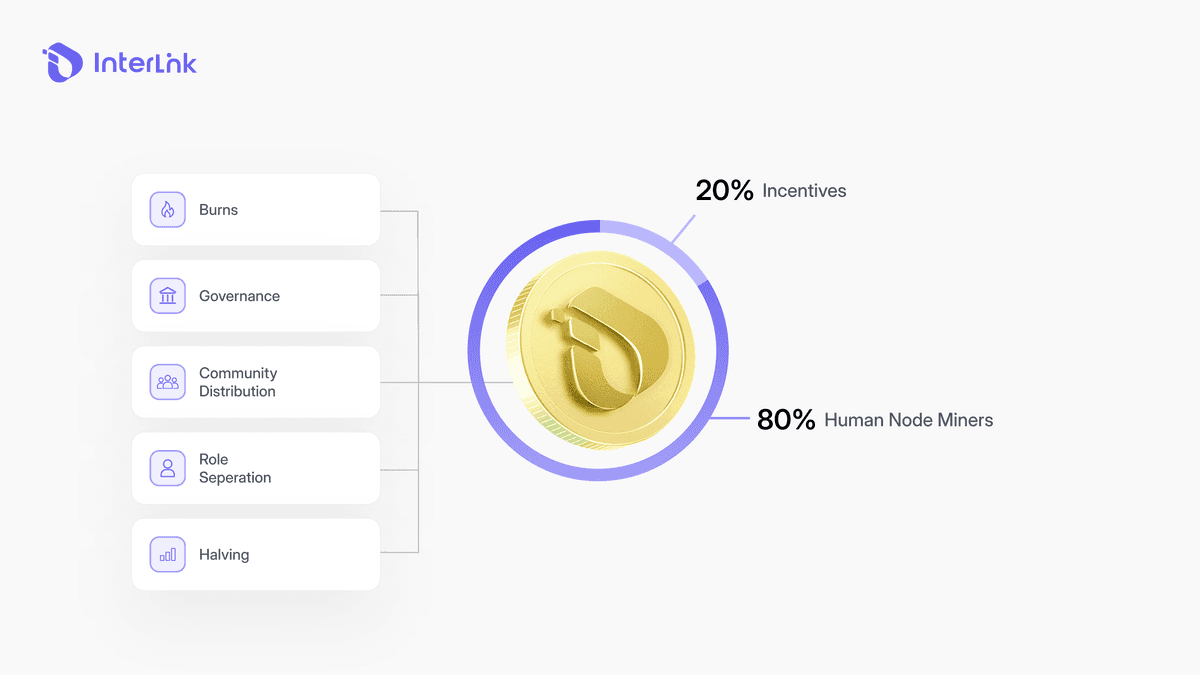
- Approximately 80% is allocated to verified Human Node miners - the people who earn tokens through Proof of Personhood and ongoing activity.
- The remaining portion supports ecosystem incentives, ambassador programs, and community campaigns.
- There are no private presales or preferential insider allocations. Human Node Miners are the first and primary recipients of newly issued ITLG.
ITL Distribution
- In the initial phase, ITL is primarily issued as staking rewards to holders of verified ITLG.
- Additional allocations exist for builders (via grants) and validators (network security rewards).
- There is no public sale or pre-mined private distribution of ITL in the initial phase.
This design follows the Distribution Pact: tokens belong first to the verified humans who earn them through participation. The InterLink Foundation operates the protocol but does not own the tokens. There is no token-based fundraising, no private DAT deals with preferential pricing, and no pre-allocated insider holdings. Every participant enters through the same path. Every ITL in circulation during the initial phase traces back to a verified Human Node who mined ITLG and committed to the staking program.
What are the Deflationary Mechanisms?
InterLink combines several tools to manage supply growth:
- Token Burn:
- ITLG: Exponential burn of pending rewards from inactive or unverified Human Nodes, plus permanent burns of a portion of returned balances.
- ITL: Three protocol-level channels - IIP-1559 base fee burn, AMM swap fee burns, and slashing burns.
- Halving: Periodic reductions in the ITLG Base Rate (emission rate). Further reductions - potentially many times - are planned as the network scales and are linked to real human participation levels.
- No private presales or preferential allocations: New supply goes first to verified participants rather than early private investors.
These mechanisms work together to slow supply growth and remove low-quality or idle tokens, linking scarcity more closely to real activity.
Why is InterLink tokenomics sustainable?
Several design choices support long-term sustainability:
- The large majority of ITLG goes to verified Human Nodes rather than private sales or team allocations.
- Burn mechanisms and Proof of Personhood reduce the impact of bots and inactive accounts.
- Progressive halvings and multiple burn channels limit uncontrolled inflation.
- Clear role separation: ITLG focuses on participation and governance; ITL serves real utility (payments, gas, reserves, RWA pairings).
- Major parameters are subject to open governance. Voting power combines ITL stake weight with InterLink ID weight to prevent capture by token concentration alone.
The model aims to reward genuine human contribution while creating structural scarcity as the network grows. Sustainability still depends on real adoption, technical execution, and market conditions.
Conclusion
InterLink Labs uses a dual-token system that separates community participation (ITLG) from network utility and settlement (ITL). By combining community-first distribution, activity-based burns, progressive halvings, and the binding Distribution Pact, the design keeps ownership aligned with verified human contribution while managing supply growth over time. Understanding these mechanics shows how value is intended to flow through the ecosystem from Human Node mining to staking, real utility, and long-term scarcity.
Disclaimer: This guide is for educational purposes only and does not constitute financial advice. Token values can fluctuate. Now that you understand the economy, learn how you can participate in governance through the InterLink DAO.

