



What Is The Interlink Dual-Token Model? ITL & ITLG Explained For Beginners
Sep 04, 2026
Our journey
If you are wondering what is InterLink dual token model, the answer starts with two tokens: ITL and ITLG. Rather than using a single token for every function, InterLink separates participation, governance, payments, reserves, and institutional access across two different assets.
The short answer is this: ITLG is designed for people, while ITL is designed for institutions. ITLG supports ecosystem participation and governance, while ITL focuses on payments, reserves, and institutional access. This guide explains how the InterLink dual-token model works, why the ecosystem uses two tokens, and how they work together to support a more sustainable Web3 economy.
What Is a Dual-Token Model in Crypto?
A dual-token model is a system where a blockchain project uses two separate tokens instead of one. Each token has a distinct job. This separation solves a common problem in Web3: when a single token is used for both everyday spending and long-term investment, price volatility can make the network unpredictable for regular users.
Key Concept: Token Utility vs. Token Governance
In most single-token projects, the same token is used for paying transaction fees, voting on governance decisions, staking for rewards, and storing value. When one token does all of these things, a drop in price affects everything. Users may stop spending because they fear losing value. Or they may stop voting because they want to hold instead.
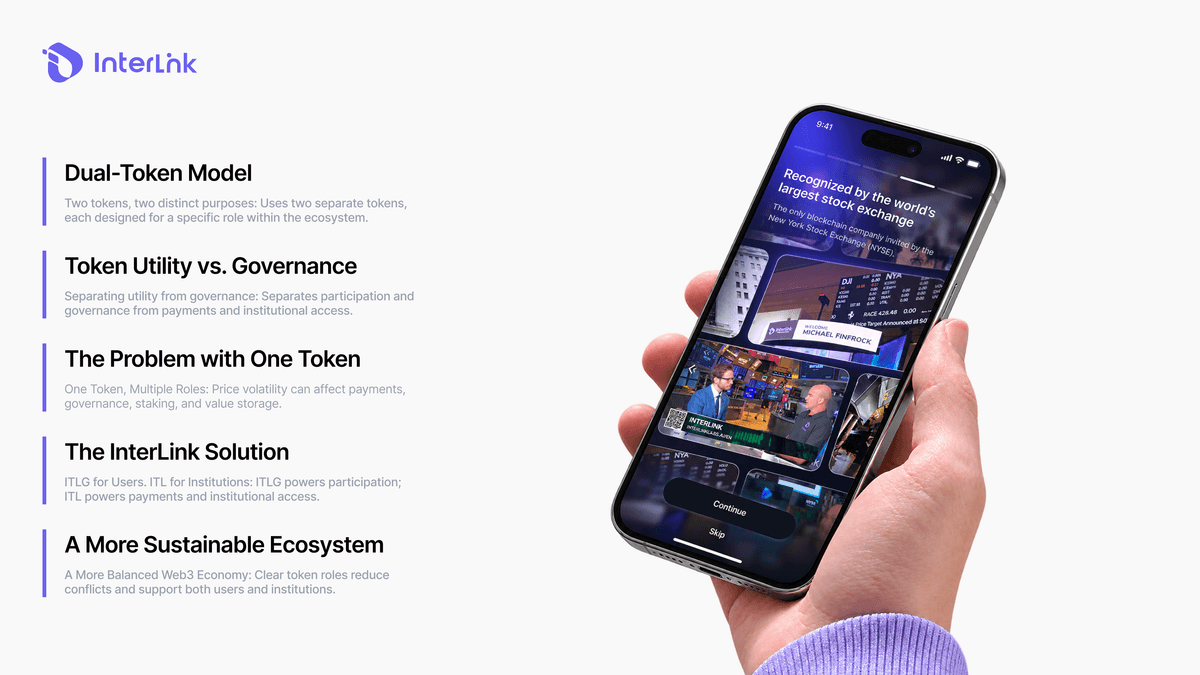
The dual-token model separates these functions into two distinct assets. One token handles user activity, participation, and governance. The other token handles payments, institutional access, and reserves. This separation allows each token to do one job well, without compromising the other.
Why Does InterLink Use Two Tokens (ITL and ITLG)?
The logic is straightforward. InterLink's tokenomics split responsibilities across two assets to prevent the problems that come with loading a single token with conflicting roles.
The Problem with One Token
Imagine if the same token was used for paying your daily coffee, voting on important network decisions, and storing your life savings. If the token price drops, you would stop spending it on coffee. If the token price rises, you would hesitate to vote because you might want to sell instead. One function undermines the other.
The InterLink Solution
InterLink separates these concerns cleanly.
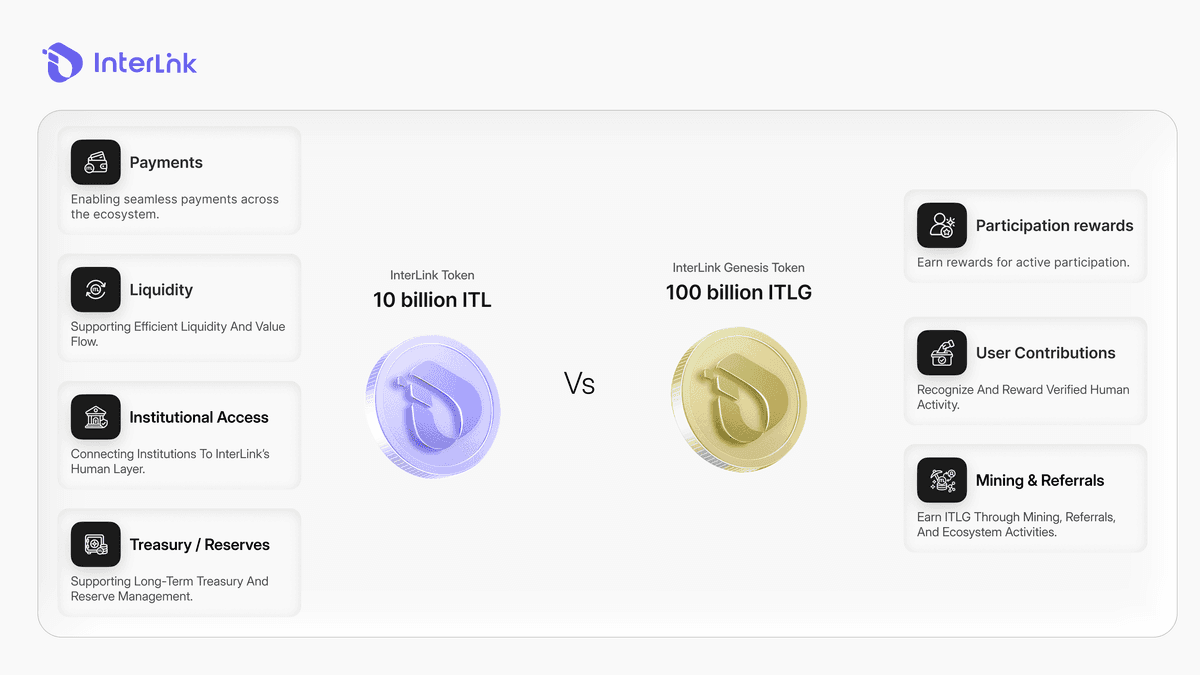
- ITLG (InterLink Genesis Token) operates on the user side. It rewards participation, enables governance, and represents active human involvement in the network.
- ITL (InterLink Token) operates on the institutional side. It handles external payments, liquidity provision, and institutional treasury management.
This design draws from a pattern already established in crypto: Bitcoin for value storage, Ethereum for utility. InterLink applies a similar division within a single ecosystem.
How Do ITL and ITLG Work Together?
Though they serve different purposes, ITL and ITLG are designed to work together in a symbiotic relationship. The connection between them is simple: stake ITLG to earn ITL.
The Symbiotic Relationship
Verified ITLG holders can stake their tokens to generate ITL rewards without losing their principal or facing slashing penalties. This mechanic ties both tokens together without requiring users to sell one for the other.
The Flow
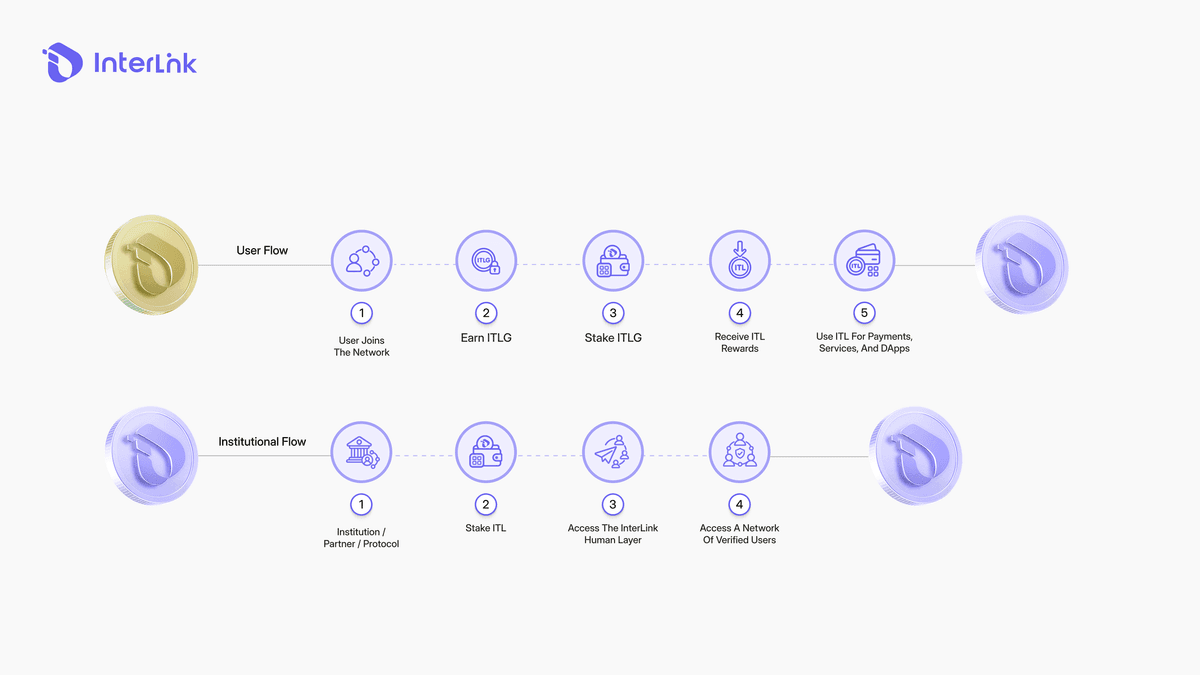
Users earn ITLG through daily participation. This includes activities like checking in, referring friends, and completing identity verification. When users stake their ITLG, they receive ITL as a reward. That ITL can then be used for payments, fees, and institutional access.
How the Tokens Flow Through the Ecosystem
Starting from the user side, the process follows a clear path. Users verify their identity and participate daily to earn ITLG. They then stake their ITLG, which locks the token and generates ITL rewards. Users can then use ITL to pay for services or dApps. On the institutional side, a different flow occurs. Partners, protocols, and platforms can stake ITL to gain access to InterLink's Human Layer, which is its verified user network. This creates demand for ITL from institutional participants while ITLG remains focused on individual users.
What Are the Benefits of a Dual-Token Model?
The dual-token model offers several important advantages for both individual users and the ecosystem as a whole.
Price Stability for Everyday Use
Because ITL handles payments and institutional functions while ITLG handles governance and participation, price volatility in one token does not directly disrupt the other. Users can participate in governance without worrying about spending their savings.
Fair Distribution
InterLink follows a strict Distribution Pact. There are no private sales or insider allocations. There is no token-based fundraising through IDO, ICO, or IEO. Human Node miners are the first and only recipients of newly issued ITLG. The token belongs to the people who earn it.
Clear Separation of Roles
ITLG handles participation, governance, and rewards for verified Human Nodes. ITL handles payments, reserves, and institutional access. ITLG has a total supply of 100 billion and is earned through mining, referrals, and activity. ITL has a fixed total supply of 10 billion and is primarily obtained through staking ITLG or institutional staking.
Long-Term Sustainability
By separating governance from utility, the model prevents one function from undermining the other. This creates a more sustainable economic engine where both individual users and large institutions can thrive together.
Real-World Utility
ITL is designed for real-world spending. Through ITLX Wallet, users can already purchase Amazon Gift Cards using crypto, with ITL next in line as the native payment asset. The project targets 10,000 payment points worldwide. ITLG, meanwhile, powers governance, DAO voting, and ecosystem participation.
Conclusion
InterLink uses two tokens because one token cannot do everything well. By separating governance and user participation (ITLG) from institutional payments and reserves (ITL), the ecosystem creates a more balanced and sustainable economy.
Disclaimer: This article by InterLink Labs is for educational and informational purposes only and does not constitute financial or investment advice. Always conduct your own research before participating in any blockchain project.
Related Articles:
- Learn more about ITL and its use cases in Cluster 17
- Discover how ITLG powers governance and rewards in Cluster 18

