


What Is InterLink Token Burn? Burn & Halving Explained
Sep 15, 2026
Our journey
One of the biggest concerns for any token holder is inflation - the fear that too many new tokens will dilute value over time. InterLink addresses this challenge with two complementary mechanisms: Token Burn (permanently removing tokens from circulation) and Halving (systematically reducing the rate of new token issuance). Together, these tools are designed to link scarcity more closely to real human participation and network activity, rather than pure speculation.
What is token burn and why does it matter?
Token burn is the permanent removal of tokens from the circulating supply. Once burned, those tokens can never be recovered or spent again. The economic logic is straightforward: when supply decreases (or grows more slowly) while demand stays stable or increases, the remaining tokens become relatively scarcer. In InterLink’s ecosystem, participation through the free mining app is part of the broader network activity that supports ongoing ecosystem usage. This can help support long-term value but only if the network continues to generate real usage and participation.
Key Concept: Token Burn
Token Burn permanently destroys a quantity of tokens to reduce total supply. It is one of the most common deflationary tools in crypto, used to counteract inflation and reward long-term, active participants.
How does InterLink’s token burn mechanism work?
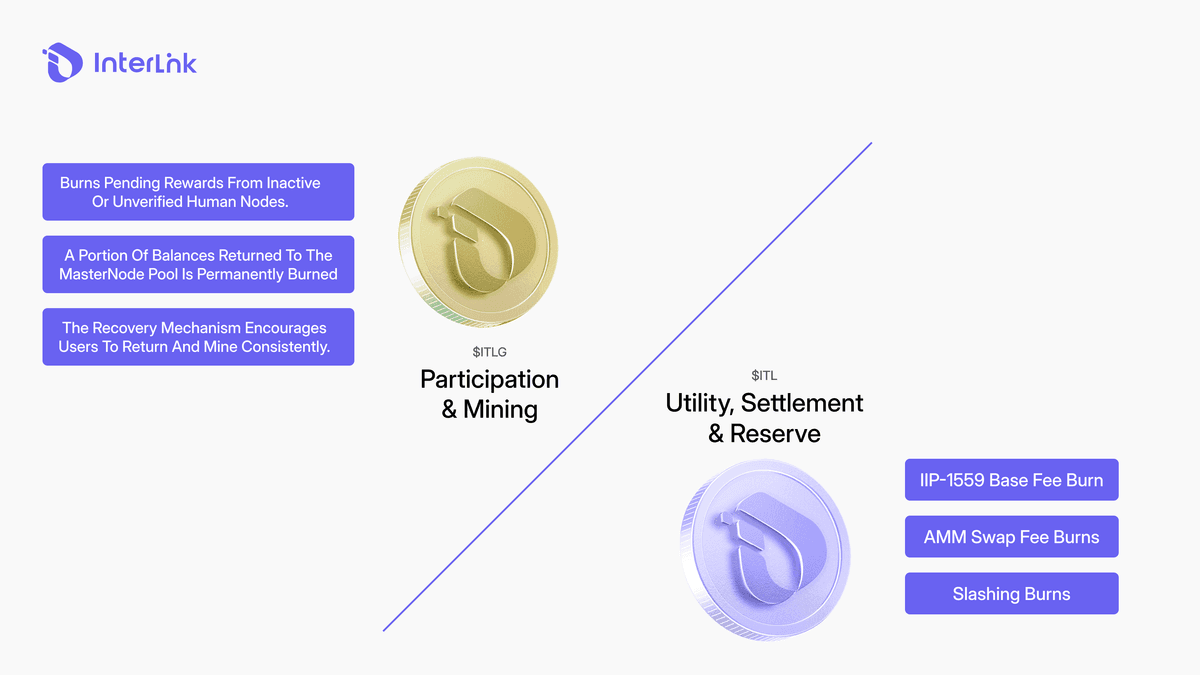
InterLink applies burn mechanisms differently for each token, matching their distinct roles in the ecosystem.
For ITLG (the participation and mining token)
- Burn targets inactive nodes to keep rewards focused on real participants.
- Inactive or long-unverified Human Nodes see their pending rewards reduced through an exponential burn formula.
- Unverified or inactive balances are returned to the network (MasterNode) pool. A portion of the returned tokens is permanently burned (according to DAO-approved rules, for example a percentage of returned supply per snapshot).
- The goal is to remove idle or low-quality supply, discourage bots and inactive accounts, and keep rewards focused on active, verified participants.
A recovery pathway exists for users who return and maintain consistent activity (streak-based). The exact recovery percentage depends on the duration of inactivity and the consistency of the user's return to mining. The permanently burned portion ensures that inactivity still carries a cost, discouraging users from abandoning their nodes without consequence.
For ITL (the utility, settlement, and reserve token)
According to the official tokenomics, ITL has three protocol-level burn channels:
- IIP-1559 base fee burn: A portion of every network transaction’s gas fee is permanently destroyed.
- AMM swap fee burns.
- Slashing burns (penalties from misbehaving validators).
- As real transaction volume grows, these burns can offset or even exceed new issuance, creating the potential for net deflation of ITL. These mechanisms are intentionally designed to tie token scarcity to genuine network activity rather than speculative cycles.
What is the halving mechanism?
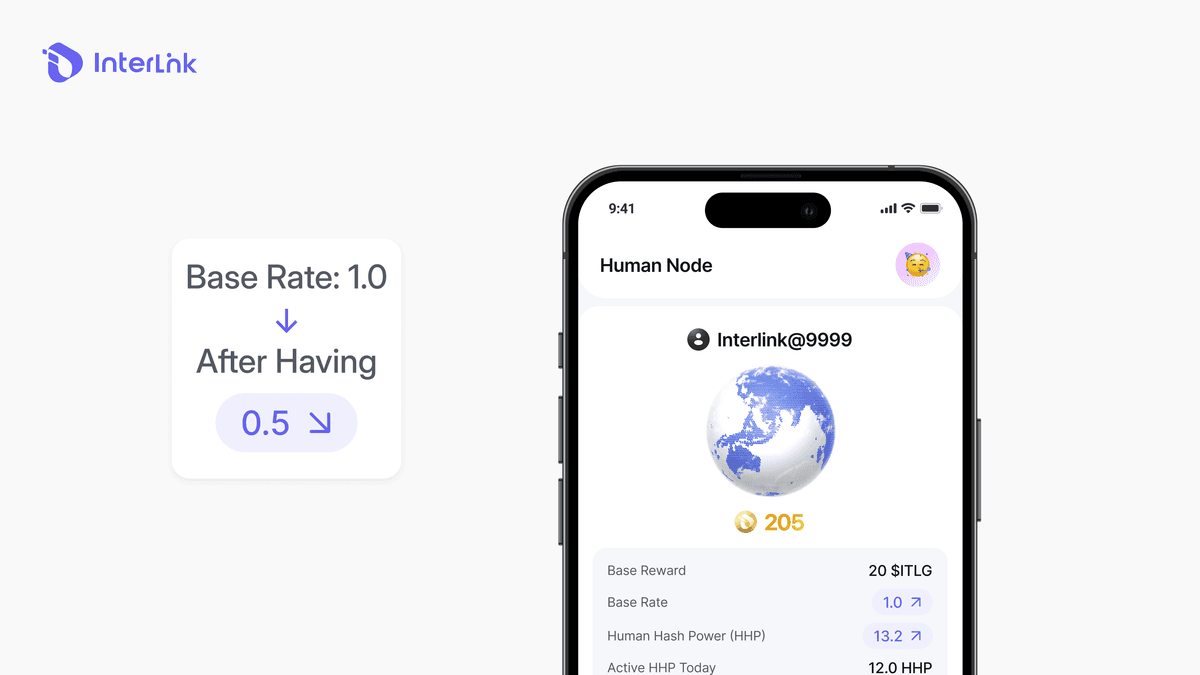
Halving is a scheduled or governance-triggered reduction in the rate at which new tokens are issued. On InterLink, halving primarily applies to ITLG through adjustments to the Base Rate in the mining formula. For example, if the current Base Rate is 1.0, a halving would reduce it to 0.5, directly reducing the ITLG rewards per mining session while keeping the HHP calculation unchanged. All users are affected equally, preserving relative fairness.
Official materials and DAO decisions indicate that further emission reductions - potentially up to around 100 times - are planned to keep issuance under control as the Human Network scales toward hundreds of millions or even one billion users. This approach draws inspiration from Bitcoin’s halving model but is adapted to the growth dynamics of a human-identity-based network.
Key Concept: Halving
Halving is an automatic or governance-driven reduction in the number of new tokens issued over time. It slows supply growth and is intended to support long-term scarcity and value preservation.
How do burn and halving protect token value?
Both mechanisms work on the supply side of the economic equation:
- Burn permanently removes existing tokens (especially idle or low-quality ones).
- Halving slows the creation of new tokens.
- When supply growth is controlled or even reversed, while real demand continues or increases (from payments, staking, governance, RWA activity, and active Human Node participation), the remaining tokens can become relatively more valuable over time.
- This design is similar in spirit to Bitcoin’s combination of fixed supply and periodic halvings, but InterLink adds activity-based burns and Proof of Personhood filters to further reduce non-genuine participation. The result is a system that aims to link scarcity more closely to real human contribution and actual network usage.
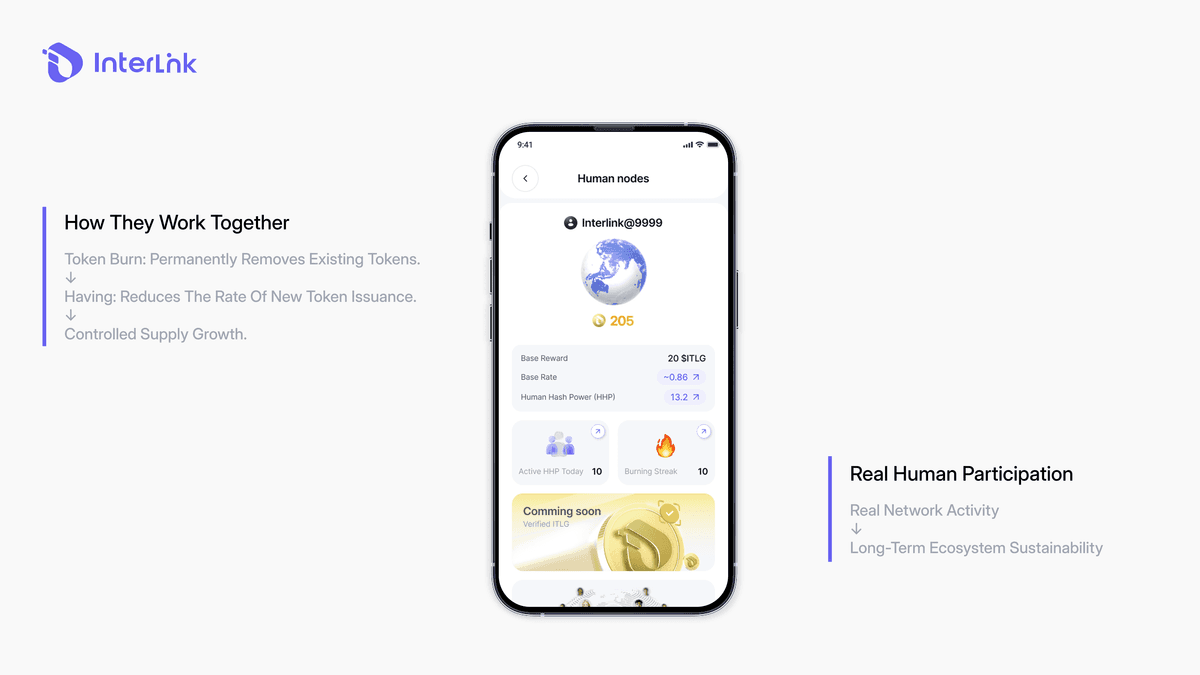
Summary of Burn and Halving Mechanisms
Conclusion
Token Burn and Halving are two of the core tools InterLink Labs uses to manage supply and support long-term sustainability. Burn removes idle and low-quality tokens, while Halving systematically reduces the rate of new issuance. Together with Proof of Personhood and activity requirements, these mechanisms aim to keep rewards focused on genuine, active Human Nodes and to create structural scarcity as the network grows. As with any crypto project, outcomes depend on real adoption, technical delivery, and market conditions. Always verify the latest parameters through official channels.
Disclaimer: This guide is for educational purposes only and does not constitute financial advice. Token values can fluctuate. Always conduct your own research before participating in any Web3 ecosystem.
Want to understand how InterLink's dual-token economy works? Read our complete Tokenomics guide.

