



What Is RWA Tokenization? Real-World Assets Explained
Oct 15, 2026
Technology
RWA tokenization is one of the most discussed ideas in Web3: turning real-world value into digital tokens that can be issued, transferred, and settled on blockchain. This guide explains what RWA tokenization is, how real assets move on-chain, why the market is growing, and how transaction-backed designs aim to improve transparency.
What Is RWA Tokenization?
RWA means Real-World Assets - value that exists outside the blockchain, such as real estate, bonds, commodities, invoices, or business economic activity. Tokenization means creating an on-chain digital representation of that value so it can be issued, transferred, and settled according to transparent rules.
An RWA token is therefore a bridge between off-chain reality and on-chain markets. Importantly, a token is not always identical to full legal ownership documents. The exact rights depend on the legal structure, the token design, and the jurisdiction.
Key Concept: Token Representation vs. Legal Ownership
An RWA token is an on-chain representation of real-world value. Legal ownership and token rights are related, but not always identical.
How Real-World Assets Move On-Chain
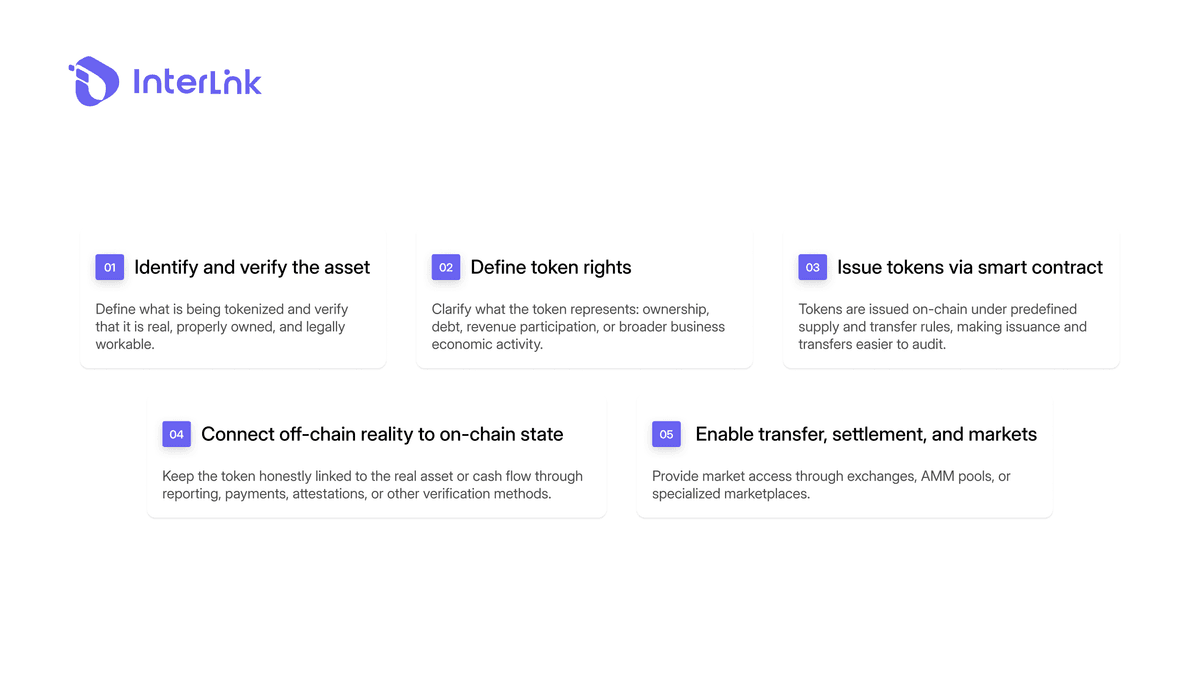
Tokenization is a process, not a single click. Most projects follow a similar sequence:
- Step 1: Identify and verify the asset - Define what is being tokenized and verify that it is real, properly owned, and legally workable.
- Step 2: Define token rights - Clarify what the token represents: ownership, debt, revenue participation, or broader business economic activity.
- Step 3: Issue tokens via smart contract - Tokens are issued on-chain under predefined supply and transfer rules, making issuance and transfers easier to audit.
- Step 4: Connect off-chain reality to on-chain state - Keep the token honestly linked to the real asset or cash flow through reporting, payments, attestations, or other verification methods.
- Step 5: Enable transfer, settlement, and markets - Provide market access through exchanges, AMM pools, or specialized marketplaces.
Key Concept: The Bridge Problem
The hardest part of RWA tokenization is not minting a token. It is keeping the on-chain token honestly connected to the off-chain asset or cash flow.
Why RWA Tokenization Matters
The appeal of RWAs comes from combining real economic value with blockchain efficiency. Potential advantages include:
- Better liquidity for assets that are normally hard to trade
- Fractional access, so more participants can take smaller positions
- Faster transfer and settlement than many traditional processes
- Greater transparency when rights and activity are recorded clearly on-chain
- Broader access to capital markets for both issuers and users
Market potential is often described as large because the underlying real-world asset base is vast. Still, potential is not the same as guaranteed adoption. Legal clarity, asset quality, and protocol design decide whether projects create durable value.
Common Types of Tokenized Real-World Assets
Not all RWAs are the same. The underlying asset changes the risk profile.
Common categories include:
- Real estate
- Government securities, bonds, and credit products
- Commodities
- Invoices and receivables
- Business activity or revenue-linked models
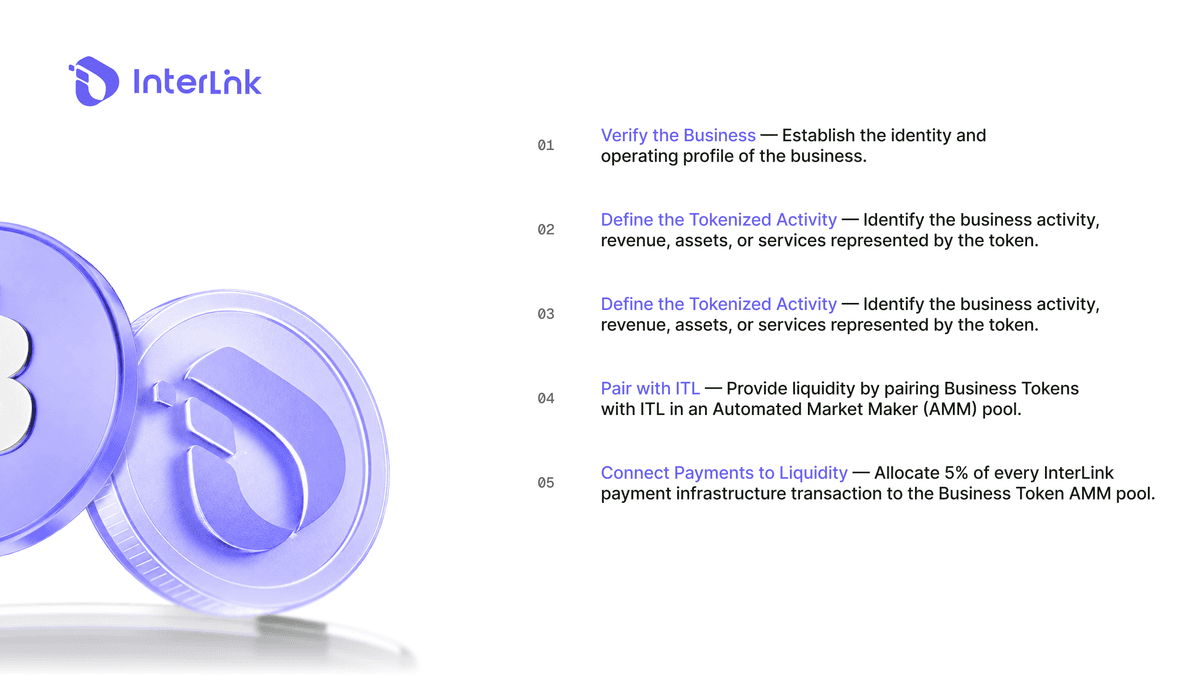
InterLink’s approach is closer to the last category. Rather than focusing only on physical assets, it emphasizes a business-focused, transaction-backed design: verified businesses can issue Business Tokens representing economic activity, pair them with ITL in protocol-embedded pools, and link on-chain support to real payment flow. This is one model among many, not the only form of RWA.
How Transaction-Backed Designs Improve Transparency
A major weakness of weak RWA models is the gap between the token and real activity. Transaction-backed designs try to close that gap. In a weak structure, a token may exist on-chain while the connection to the real asset depends mostly on off-chain promises or infrequent reports. In a stronger structure, observable commercial activity helps support the token’s market and liquidity over time.
InterLink’s Transaction-Backed Digital Assets approach illustrates this idea: when payments are processed through the network’s payment infrastructure, a portion of value can be routed into the Business Token’s market structure. Combined with $ITL as the settlement and reserve asset, this aims to make on-chain value more closely related to real commercial throughput.
Key Concept: Transaction-Backed Transparency
Transparency improves when token value is linked to observable commercial activity, not only to off-chain reports.
Benefits and Risks of RWA Tokenization
RWA tokenization creates new opportunities, but it also introduces new failure points.
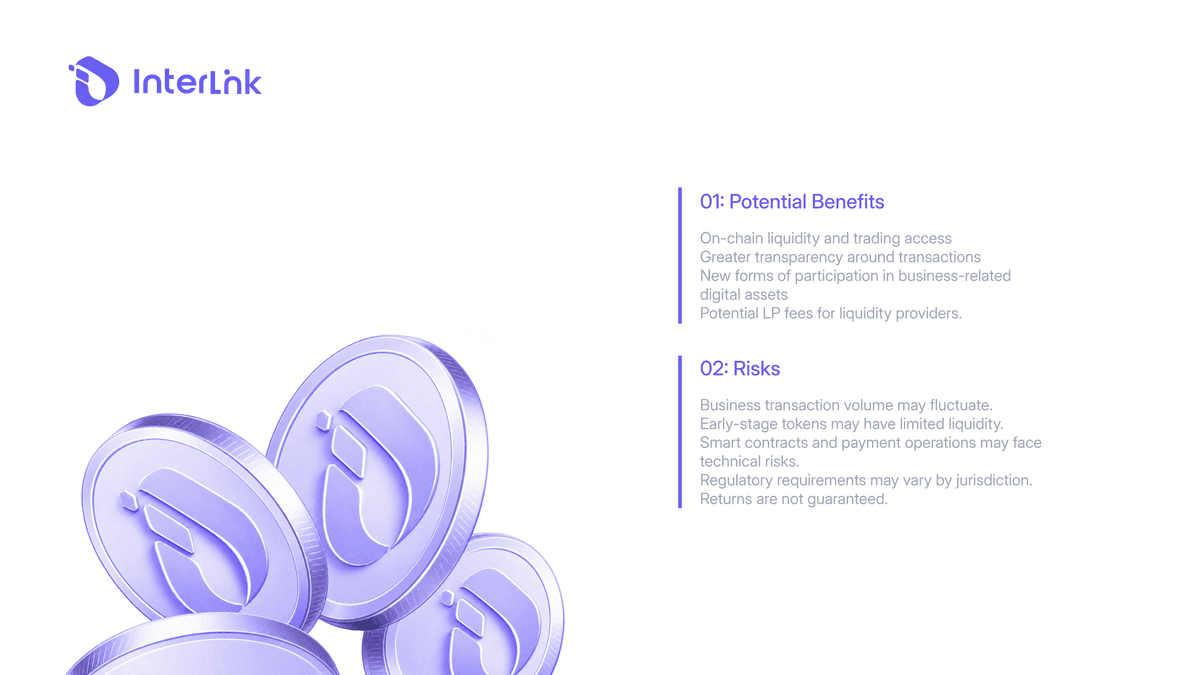
Potential benefits
- More flexible access to capital and liquidity
- Fractional participation
- Faster transfer than many traditional processes
- Clearer audit trails when rules and transfers are on-chain
Key risks
- Legal and regulatory uncertainty by country
- Poor-quality underlying assets
- Weak off-chain data or oracle risk
- Smart contract vulnerabilities
- Limited market liquidity in early stages
- No guaranteed return
Conclusion
RWA tokenization turns real-world value into on-chain tokens that can be issued, transferred, and settled under clear rules. The strongest designs keep tokens linked to real activity; for example through transaction-backed models such as InterLink’s. Market potential is large, but results still depend on legal clarity, asset quality, and protocol design.
Disclaimer: This guide from InterLink Labs is for educational purposes only and does not constitute financial, legal, or investment advice. Always do your own research.

