



How To Stake Crypto In 2026: Complete Crypto Staking Rewards Guide
Nov 03, 2026
Technology
Crypto staking has grown from a niche validator activity into a mainstream yield strategy, with over $200 billion in total value locked across major proof-of-stake networks in 2026. For newcomers, staking offers a way to earn passive income while contributing to network security. But not all staking models work the same way.
Some require running validator nodes, while others let you stake directly from your wallet. This guide explains how to stake crypto step by step, compares staking methods and rewards, and shows how ITLG staking on InterLink introduces a unique conversion model.
If you are still exploring Web3, you may have already come across terms like free mining app or free crypto app while looking for ways to earn your first tokens. Staking is often the natural next step after that, because it turns idle holdings into an active yield strategy.
What Is Crypto Staking?
Staking is often described simply as "earning interest on crypto," but the mechanism behind it is more nuanced. Understanding what staking actually does, and why networks reward it, is essential before committing any assets.
Definition and Core Concept
Crypto staking is the process of locking digital assets to support the operations and security of a proof-of-stake (PoS) blockchain network. In return, participants receive rewards, typically paid in the network's native token. When you stake, your tokens act as collateral that incentivizes honest validator behavior. The network randomly selects validators to propose and validate new blocks, with selection probability proportional to the amount staked.
Unlike traditional savings accounts, staking rewards are not guaranteed by a central institution. They are protocol-defined and depend on network participation rates, token inflation, and validator performance. For established networks, staking yields typically range from 3% to 15% APY.
How Staking Works, Step by Step
The staking process follows a clear structure:
- Choose a network and asset: Select a PoS blockchain (Ethereum, Solana, Polkadot) and acquire its native token.
- Choose a staking method: Stake natively, delegate to a validator, use a staking pool, or use a liquid staking protocol.
- Lock or delegate tokens: Depending on the method, your tokens are locked in a smart contract or bonded to a validator. Some networks have minimums (e.g., 32 ETH).
- Earn rewards: Rewards are distributed periodically (e.g., Ethereum distributes roughly every 6.4 minutes).
- Unstake or withdraw: Note the cooldown period. Ethereum has an exit queue that can take days to weeks.
The Role of Validators and Delegation
Validators are the backbone of any PoS network. They run specialized software, maintain uptime, and validate transactions. Validators who fail to perform their duties can be penalized through slashing, where a portion of their staked tokens is destroyed. For users who do not want to run a validator, delegation allows you to assign your tokens to an existing validator and share in the rewards.
How to Stake Crypto Step by Step (Methods Compared)
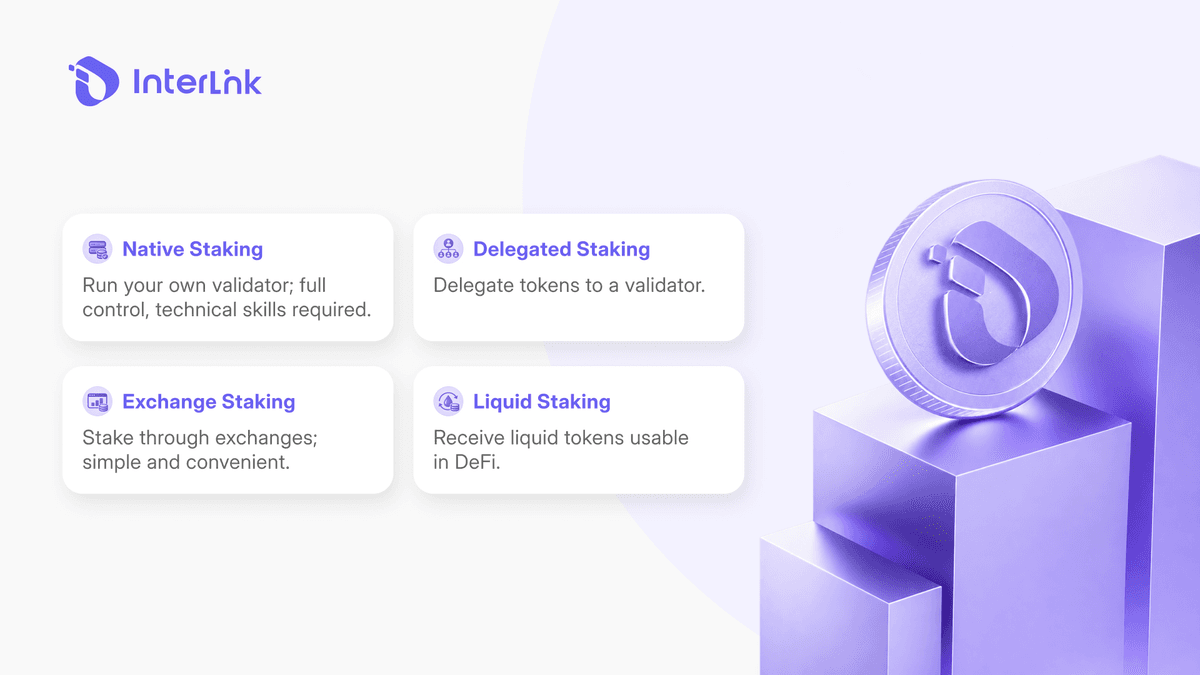
The exact process of staking depends on the network and the method you choose. Here are the four most common scenarios.
1. Native Staking (Running Your Own Validator)
- Requirements: Dedicated server, stable internet, minimum staking amount (e.g., 32 ETH), and command-line skills.
- Pros: Full control, highest rewards, no counterparty risk.
- Cons: Technical complexity, slashing risk if misconfigured.
2. Delegated Staking (Staking Through a Validator)
- Process: Open your wallet, go to the staking section, select a validator, enter the amount, and confirm.
- Pros: Simple, no technical setup, flexible amounts.
- Cons: Validator performance affects rewards, lock-up periods may apply.
3. Liquid Staking
- Process: Protocols like Lido or Rocket Pool give you a liquid derivative token (e.g., stETH) in return for your staked ETH. You can use stETH in DeFi while the underlying asset earns rewards.
- Pros: Maintains liquidity, composable with DeFi.
- Cons: Smart contract risk, derivative token may trade at a discount.
4. Exchange-Based Staking
- Process: Centralized exchanges (Binance, Coinbase, Kraken) handle the technical side. You just deposit tokens and select a product.
- Pros: Simplest option, instant liquidity on flexible products.
- Cons: Custodial risk, lower yields due to exchange fees.
Crypto Staking Rewards in 2026 and How They Work
Staking rewards are not a fixed interest rate. They are dynamic and influenced by several factors. Rewards come from two main sources: inflation (newly minted tokens) and transaction fees.
The annual percentage yield (APY) depends on:
- Total value staked: As more tokens are staked, the yield drops (e.g., Ethereum's yield fell from 5% to ~3.5%).
- Network inflation rate: Fixed or dynamic depending on the chain.
- Validator performance: Missed attestations reduce rewards.
- Commission fees: Validators take a cut (typically 5% to 10%).
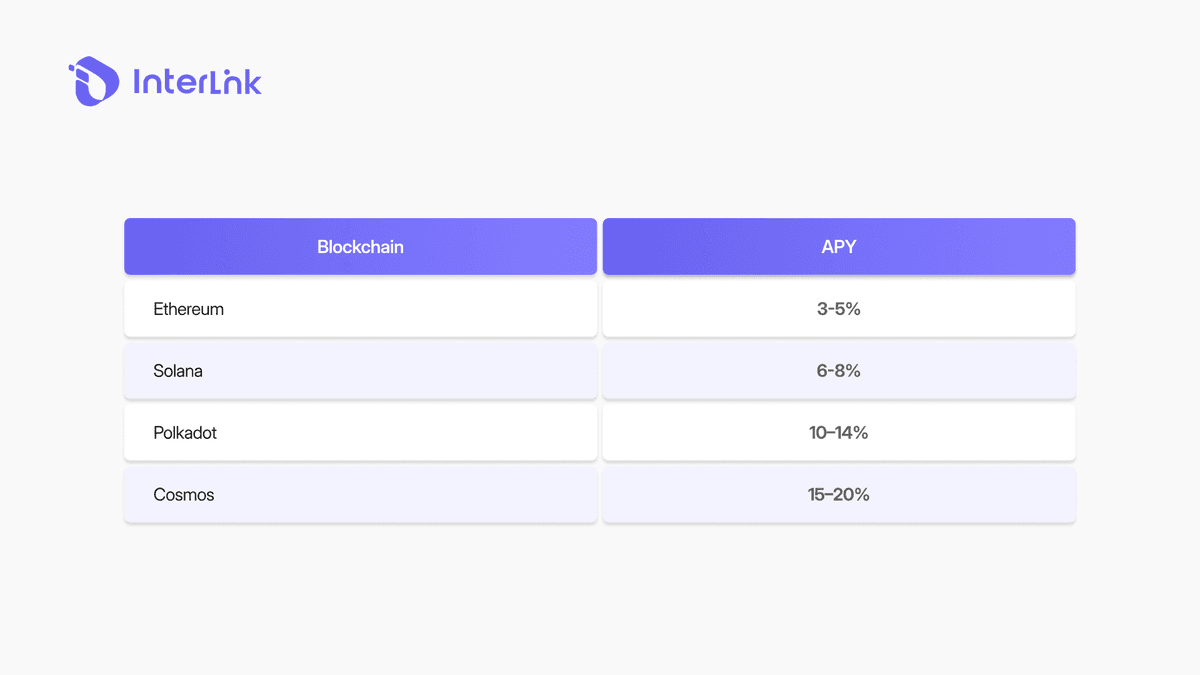
Reward Distribution Across Major Networks
Rates are indicative and fluctuate with market conditions and network participation.
Compounding and Auto-Restaking
Most setups allow you to claim rewards and restake them, effectively compounding your returns. A 5% APY compounded annually becomes roughly 6.4% effective yield over five years.
ITLG Staking on InterLink: A New Staking Model
While traditional staking relies on APY, InterLink Labs introduces a fundamentally different approach with ITLG Staking. Instead of earning passive rewards from inflation, users convert their ITLG tokens into ITL (the network's utility token) through a commitment-based conversion model defined by DAO Proposal 16.
The key principle is simple: your ITLG never leaves your wallet. Only the converted ITL is subject to the lock and vesting schedule. The conversion ratio improves with longer commitment; ranging from 60 ITLG to 1 ITL (0-year lock) up to 1.875 ITLG to 1 ITL (5-year lock).
If you want to explore the exact conversion ratios, lock schedules, and step-by-step examples, read our full guide on how to stake ITLG and receive ITL rewards.
Staking Risks to Know Before You Stake
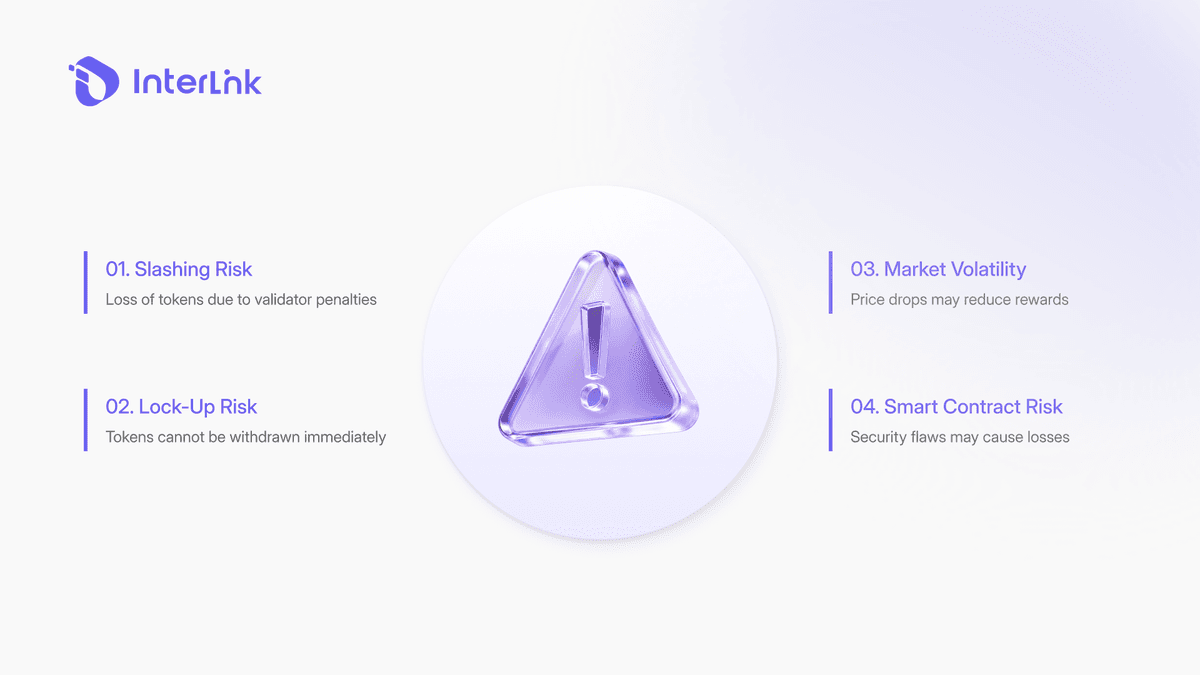
Staking is not risk-free. Understanding these risks is essential for making informed decisions.
- Slashing Risk: A penalty imposed on validators for going offline or signing conflicting messages. Choosing a reputable validator mitigates this. (Note: ITLG staking on InterLink has no slashing risk).
- Lock-Up and Opportunity Cost: Most staking involves a lock-up period. If the token price drops significantly, you cannot react.
- Market Volatility: Staking is not a hedge against price declines. If the token price falls 40%, your rewards may not compensate for the loss.
- Smart Contract Risk: Liquid staking and pools involve smart contracts. Bugs or exploits can lead to loss of funds.
How to Choose the Right Staking Method
The best method depends on your technical skills, risk tolerance, and liquidity needs.
- Maximum Simplicity: Use exchange-based staking.
- Maximum Control and Rewards: Run a native validator.
- Flexibility: Use liquid staking to keep your capital liquid.
- Balanced Commitment: Consider ITLG staking, where you choose your lock period for better conversion ratios.
Factors to Evaluate:
- Yield potential: Compare APY across platforms.
- Liquidity: How quickly can you unstake?
- Risk profile: Slashing, smart contract, and counterparty risks.
- Token utility: Does the reward token have governance rights or utility? (Learn more about the utility of ITL).
- Minimum stake: Can you start with a small amount?
Conclusion
Crypto staking has become one of the most accessible ways to earn yield in Web3. For beginners, exchange-based or delegated staking is the simplest entry point. Liquid staking provides yield without sacrificing liquidity.
InterLink's ITLG staking stands out with its fixed conversion model under DAO Proposal 16, where longer commitments unlock better ratios. If you started with a free crypto app, staking is a natural next step to put your tokens to work. To maximize your returns, consider exploring other strategies like earning passive income with crypto.
Disclaimer: This guide is for educational purposes only and does not constitute financial advice. Staking involves risk, including the potential loss of principal.

