

Nov 20, 2026
Technology
The real world asset (RWA) market has crossed the $40 billion mark, yet a fundamental paradox defines its current state. Tokenization has matured, but liquidity has not. The vast majority of tokenized assets remain dormant, functioning as digital records rather than liquid financial instruments. This article dissects the structural roots of the RWA liquidity crisis, presents concrete market data, and examines how InterLink Labs addresses this through its Transaction Backed Digital Assets Protocol and protocol embedded AMM infrastructure.
The narrative of tokenization often emphasizes market capitalization. However, on-chain data reveals a stark disconnect between issuance and actual economic throughput.
A comprehensive report by BeInCrypto Research, titled Real State of Tokenization in 2026, tracked roughly $60 billion across over 7,000 products. The findings were alarming. 56% of the measured market, represented by 910 out of 1,289 assets valued above $100,000, recorded zero weekly transfer activity.
These dormant assets represent $32.9 billion in value that is effectively locked, unable to circulate through DeFi or secondary markets. Furthermore, only 379 assets showed any weekly movement, accounting for $26.2 billion in active value.
Pantera Capital’s State of Tokenization, September 2026 reinforces this stratification. While the total market for 671 tokenized assets reached $331.8 billion, permissioned assets, comprising 59% of market capitalization, contributed merely 0.2% of spot trading volume. In contrast, open access assets, representing 41% of market cap, drove 99.8% of volume.
The turnover rate disparity is extreme. Tokenized stocks achieved a 204.6% monthly turnover, whereas interest rate products languished at 0.1%. The average Tokenization Proficiency Index (TPI) score across the market was a mere 2.04, indicating most assets are simple on chain wrappers lacking native operational functionality.
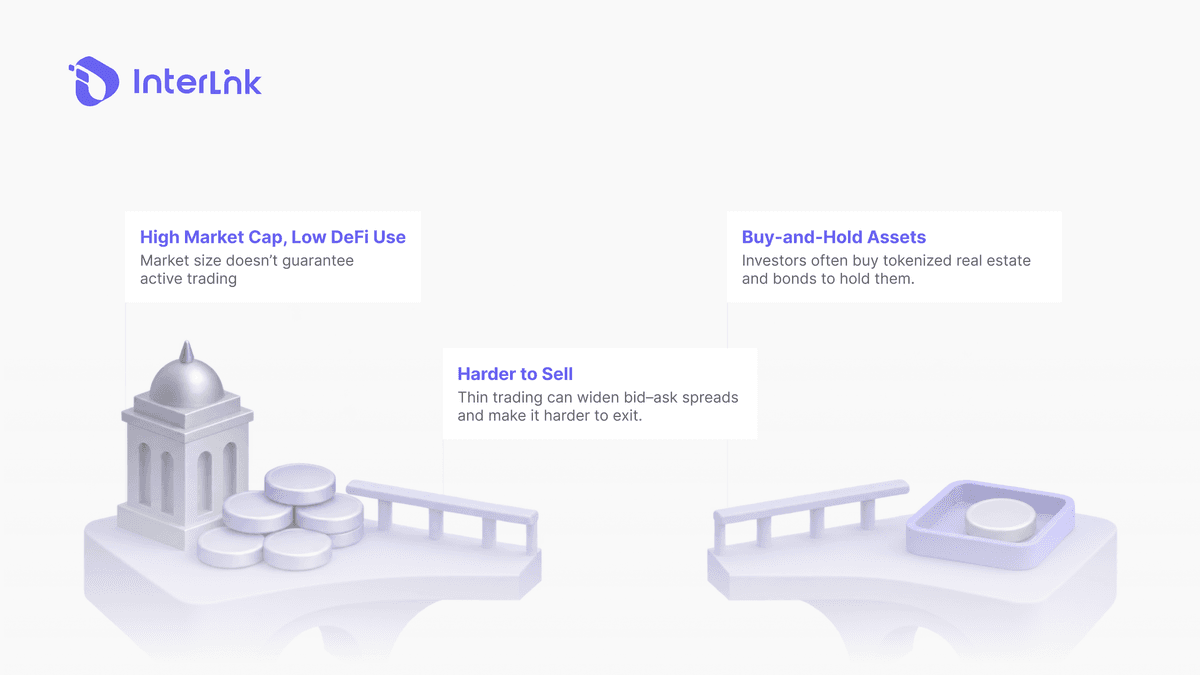
Why does this dormancy persist? The root cause is the static asset model. Real estate, government bonds, and private credit are designed for long term holding, not frequent trading. They generate yield but not daily transactional volume. Without natural trading activity, market makers lack incentive to provide depth.
This leads to wide bid ask spreads and severe slippage for any holder attempting to exit. The asset may be stable, but it is also entirely illiquid. As BeInCrypto’s report concludes, the next phase of tokenization depends less on launching more assets, and more on building infrastructure that allows assets to move, settle, and comply.
Read more: What Is the InterLink IBTE Marketplace? Tokenized Business Revenue
InterLink’s approach diverges fundamentally from the static asset paradigm. Rather than tokenizing assets that sit idle, the Transaction Backed Digital Assets Protocol tokenizes active business revenue, which is economic activity that is continuously moving.
According to the InterLink whitepaper, this protocol is an economic architecture designed to connect real world business activity with on-chain digital asset formation through automated market maker (AMM) based liquidity infrastructure. Any business holding a verified InterLink ID can tokenize its operations into a Business Token (BT), an IRC-20 token representing its economic activity on a chain.
The critical distinction is that the token’s value is not anchored to a static off chain asset. Instead, it is mathematically collateralized by the business’s throughput, which is its actual transaction volume.
Liquidity is solved at the protocol level, not through third party market makers. Upon issuance, each Business Token is automatically paired with ITL in a protocol embedded AMM pool using a constant product formula. This creates chain liquidity from day one.
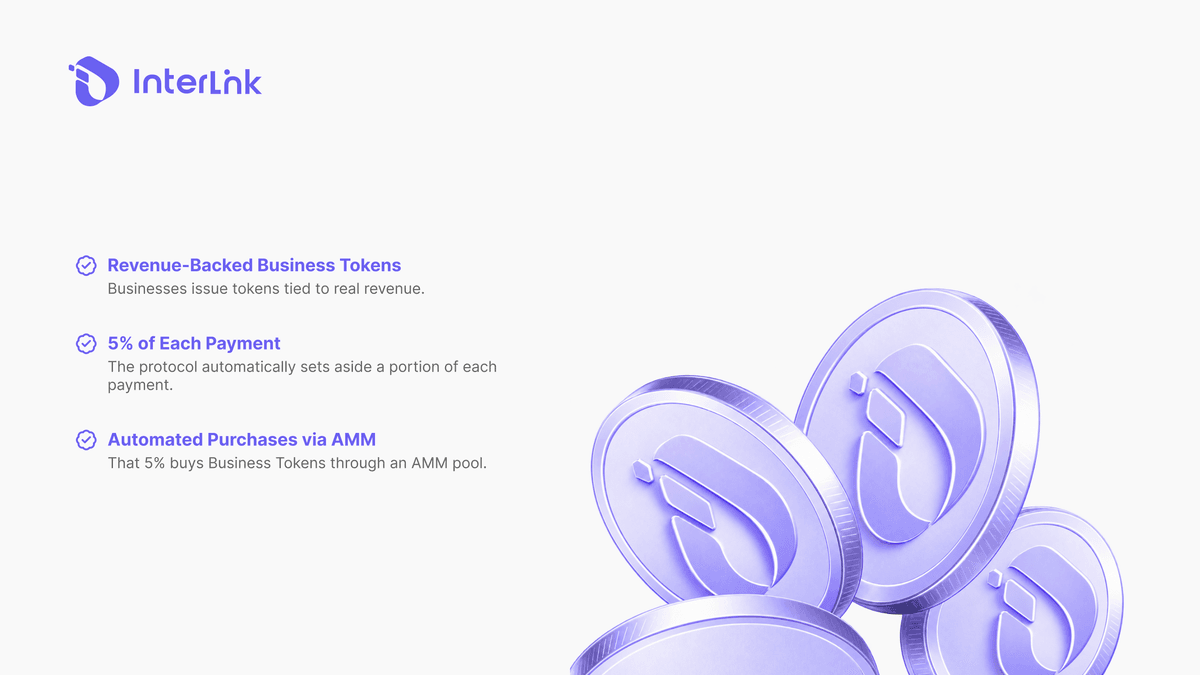
The engine of sustained demand is the Automated Value Capture Mechanism. A defined micro percentage of every payment processed through InterLink’s payment infrastructure is algorithmically diverted into BT's AMM pool. Specifically, 5% of every transaction is routed to buy the business’s tokenized asset. Per the whitepaper, this Value Capture allocation is split into a market buy and a paired liquidity deposit.
To illustrate, if a partner coffee shop processes $10,000 in daily sales via InterLink Pay, $500 is automatically routed to the AMM. This creates a persistent buy side demand proportional to real commercial volume. Simultaneously, the paired liquidity deposit grows the pool, which deepens liquidity and reduces slippage for all holders.
Liquidity providers additionally earn 0.3% of every BT/ITL swap. ITL serves as the universal reserve and settlement currency for all trading pairs, ensuring a controlled and verifiable supply anchored to verified ITLG. Ultimately, up to 10,000 businesses can register as payment points, tokenizing their operations directly on chain.
Read more: What Is RWA Tokenization? Real-World Assets Explained
While the revenue backed model addresses the liquidity flaw of static assets, it introduces distinct risk vectors that investors must evaluate.
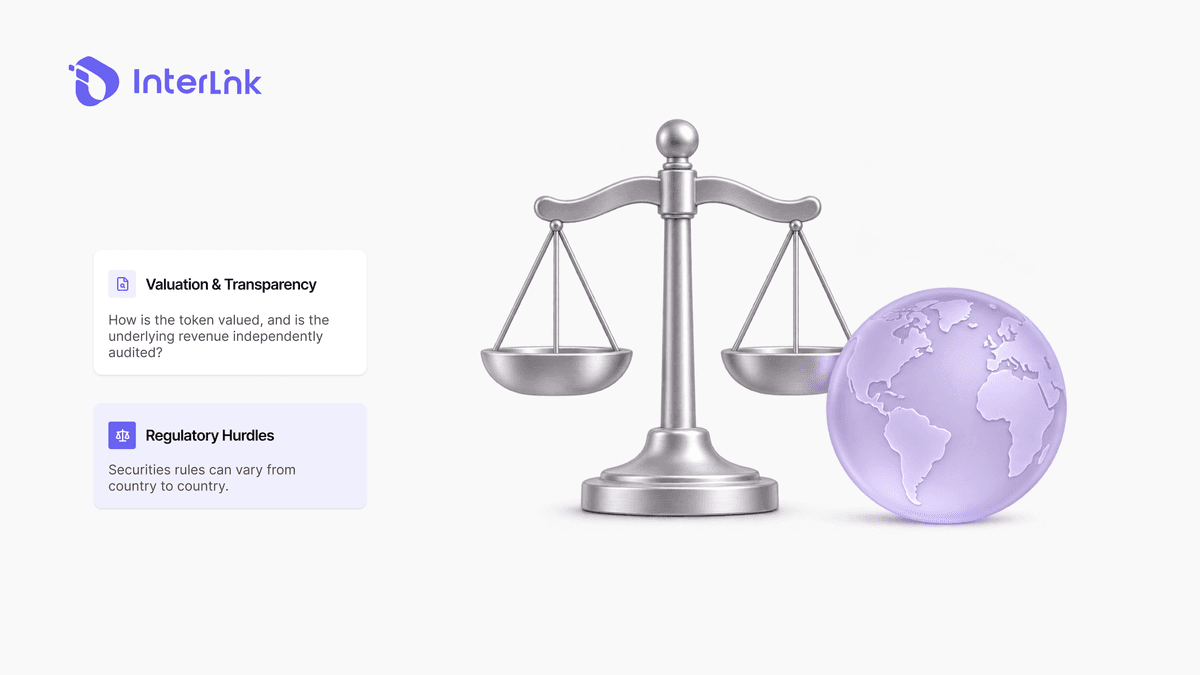
The value of a Business Token depends on the accuracy of the business’s reported chain transaction volume. Without independent audits of the underlying commercial activity, there is a risk of overvaluation. Investors must verify that the cash flows driving AMM demand are genuine and not manufactured.
BT prices remain subject to market volatility. Exit via the AMM can still incur slippage if pool depth is insufficient relative to trade size. Liquidity providers face impermanent loss when the relative price of BT and ITL diverges. Furthermore, BT holders do not receive cash dividends. Their economic return is entirely dependent on continuous AMM buy pressure from real commerce.
Tokenizing business revenue may be classified as a security in many jurisdictions, requiring compliance with KYC, AML, and securities laws. The protocol’s design, which avoids direct distributions to preserve permissionless participation and regulatory clarity, mitigates but does not eliminate this risk. Additionally, all DeFi protocols carry inherent smart contract vulnerabilities.
A critical, often overlooked risk is the reliance on self reported metrics. InterLink’s user and transaction figures have not been independently audited. The project’s model draws structural comparisons to earlier mobile mining ventures that failed to achieve commercial viability. Investors must weigh the protocol’s technical design against the absence of third party verification of its operational scale.
Read more: How To Tokenize Business Revenue: SME Guide 2026
The future of RWA tokenization does not lie in digitizing static assets that remain dormant in wallets. It lies in connecting real, moving cash flows on chains. InterLink’s Transaction Backed Digital Assets Protocol offers a structurally different solution. Liquidity is generated programmatically from commercial activity rather than speculative trading. For investors navigating the RWA landscape, understanding the distinction between static, illiquid wrappers and revenue backed, AMM anchored assets is essential to avoiding the traps that have ensnared 56% of the tokenized market.
Disclaimer: This guide is for educational purposes only and does not constitute financial advice. Always conduct your own research.
Read more: Business Token vs Stock: IPO Alternative For SMEs?


