


Crypto App For Unbanked: A New Path To Financial Inclusion
Oct 20, 2026
Technology
For the 1.4 billion adults who remained unbanked in 2021, access to financial services can still be limited by documentation, cost, infrastructure, and other barriers. This article explores how blockchain and crypto could support financial inclusion, and how InterLink combines digital identity, Proof of Personhood, and Web3 services to create a potential entry point to the digital financial ecosystem.
Why Financial Inclusion Still Matters for the Unbanked
Financial inclusion is not just about having a bank account; it is about access to payments, savings, credit, and the ability to participate in the digital economy. Understanding who the unbanked are and why they remain excluded helps frame why Web3 solutions like InterLink matter.
The Scale of the Problem
According to the World Bank's Global Findex 2021, around 1.4 billion adults, or 24% of adults worldwide, remained unbanked. Although global account ownership reached 76%, significant gaps remained among lower-income populations. The World Bank also notes that 1.3 billion people lack formal identity documentation; a key barrier that prevents access to financial services in the first place.
Common Barriers to Financial Access
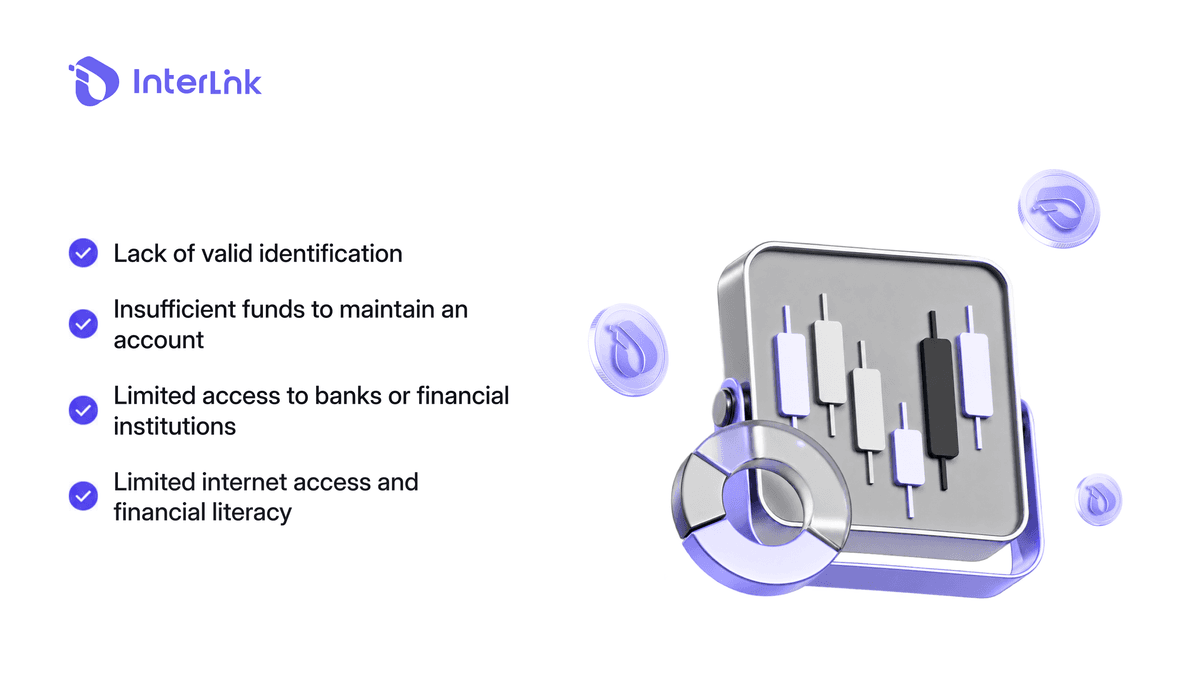
An unbanked person does not have an account with a formal financial institution, while an underbanked person may have an account but still lacks reliable access to financial products. Common barriers include insufficient money to maintain an account, lack of required identification, distance from banks, limited internet access, and low financial literacy. These challenges explain why smartphones and digital financial services have become increasingly relevant to financial inclusion.
How Crypto Could Support Financial Inclusion
Crypto is not a guaranteed solution to financial exclusion. Blockchain networks, digital wallets, and decentralized applications still involve technical, regulatory, security, and usability challenges. However, they introduce an alternative infrastructure that could complement existing financial systems in some markets.
Smartphone-Based Access to Digital Finance
A smartphone can provide access to digital wallets, payment applications, and blockchain-based services without requiring users to visit a traditional bank branch. For people living far from financial institutions, this can reduce one physical barrier to participation. The broader success of mobile money also demonstrates how phones can serve as an important gateway to financial services.
Cross-Border Payments and DeFi Access
Crypto-based payment systems could potentially make some cross-border transfers faster or more accessible by allowing value to move through blockchain networks. This may be particularly relevant to people who depend on international remittances. Decentralized finance (DeFi) also uses blockchain and smart contracts to provide services such as token swaps and lending without relying entirely on a traditional financial institution. However, practical benefit depends on transaction fees, local regulations, liquidity, and the ability to convert digital assets into local currency.
HumanPad – Supporting Access for the Unbanked
For people who lack access to suitable smartphones or devices for biometric verification, even the most accessible Web3 service can remain out of reach. HumanPad is designed to address this gap directly.
HumanPad is a compact, AI-powered device, roughly the size of an iPod Shuffle, equipped with an AI-powered camera system and high-resolution sensors specifically optimized for human verification. It is designed to be worn, not carried, positioning it as a future wearable AI device.
While the World Bank counts 1.4 billion unbanked adults globally, HumanPad specifically targets the 1.3 billion people who lack formal identity documentation; a key barrier to accessing financial services. Beyond identity verification, HumanPad represents a gateway to financial inclusion. It can serve as a trusted verification point for lending, borrowing, savings, micropayments, and basic financial access.
How InterLink Creates a Digital Entry Point for the Unbanked
InterLink's approach to financial inclusion is built on a simple premise: verify a real human once, then give them access to a full ecosystem of Web3 services. This section explains how InterLink ID and Proof of Personhood create that entry point.
InterLink ID and Multi-Layered Privacy
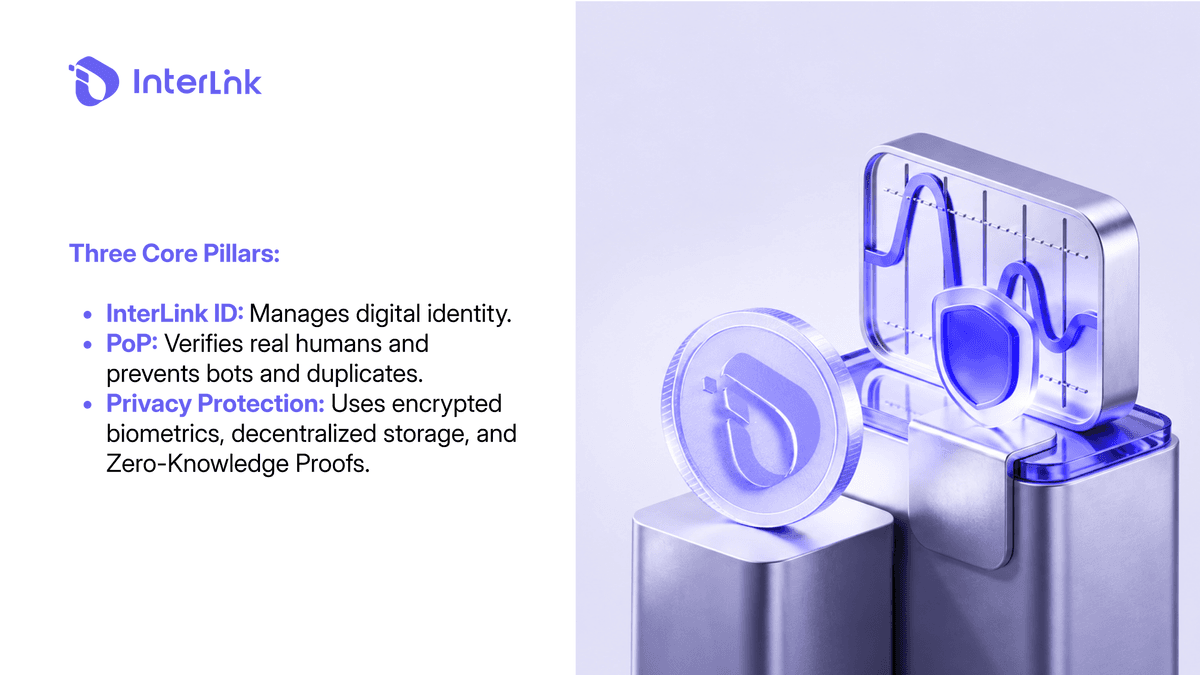
InterLink ID functions as the digital identity layer within the InterLink ecosystem. It follows Self-Sovereign Identity (SSI) principles, meaning users own and control their credentials rather than relying on a central authority. The system is built on three foundational pillars: encrypted biometric data (no raw biometric information is ever stored or exposed), decentralized storage (identity data stored across IPFS or Arweave), and zero-knowledge proof readiness (users can prove statements without disclosing underlying data).
Proof of Personhood and Verified Participation
Proof of Personhood (PoP) is designed to verify that an account belongs to a unique human rather than a bot or duplicate account. InterLink uses facial verification and liveness-related mechanisms as part of this process. A verified-human layer can help Web3 applications support genuine participation and reduce risks associated with automated or duplicated accounts.
One Identity Across the Ecosystem
InterLink is designed around a shared identity layer, allowing users to connect their verified identity with supported applications and the ITLX Wallet. Instead of creating a separate identity for every service, users can access different parts of the ecosystem through their InterLink ID. This can provide a more connected and accessible experience for people who are new to Web3.
How to Create an InterLink Digital ID and Get Started
Getting started with InterLink requires only a smartphone and a few minutes. The process is designed to be accessible to users regardless of their prior experience with crypto or financial services.
Step 1: Start With the InterLink App
Begin by opening the InterLink App and signing in or creating an account. Users should have a compatible smartphone and follow the latest requirements shown in the official application. The app serves as the main gateway for managing InterLink ID and accessing supported ecosystem services.
Step 2: Complete Human Verification
The next stage involves completing InterLink's Proof of Personhood process. The system uses facial verification and liveness-related checks to establish that the participant is a real, unique human. InterLink states that its PoP design uses on-device processing and cryptographic proofs rather than retaining or transmitting the original biometric image to central servers.
Step 3: Create and Verify Your InterLink ID
After completing the human verification process, users can create and verify their InterLink ID. This verified identity serves as a digital access layer within the InterLink ecosystem, helping users connect to supported applications and services. The InterLink ID can be used across different parts of the ecosystem where verified identity is supported.
Step 4: Access InterLink Web3 Services
Once the InterLink ID is verified, users can begin exploring the Web3 services available within the ecosystem. These may include Mini-Apps, wallet functions, decentralized applications, and other supported Web3 features. The verified identity can work alongside the ITLX Wallet, giving users a connected starting point for interacting with digital assets and blockchain-based applications.
How to Enter the InterLink Decentralized Financial Ecosystem
Once a user has a verified InterLink ID, they can access a range of decentralized financial services. These services are designed to provide utility beyond simple asset storage.
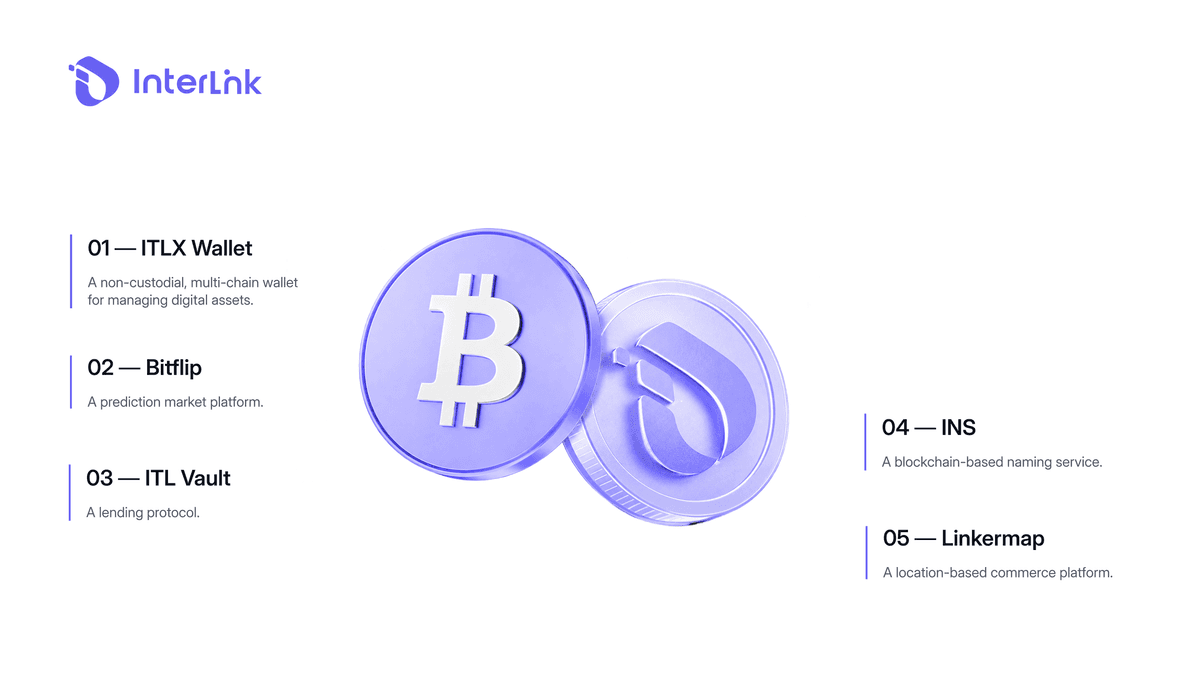
Users can access the ITLX Wallet; a non-custodial, multi-chain wallet, to manage supported digital assets and connect with DeFi and dApps. Supported applications include prediction markets (BitFlip), lending protocols (ITL Vault), naming services (INS), and geo-commerce platforms (LinkersMap).
In the current phase, stablecoins (USDT, USDC) are the accepted payment method inside ITLX Pay, giving users immediate real-world utility. As the ecosystem matures, ITL is next in line as the native payment asset inside ITLX Pay. ITLG supports participation and governance within the ecosystem.
In simple terms, the journey connects InterLink ID → InterLink App → ITLX Wallet → Web3 and DeFi services, giving users a more connected way to participate in the ecosystem.
Real-World Use Cases for the Unbanked
The potential of InterLink Labs for unbanked populations is best understood through concrete examples. Several use cases already demonstrate how verified digital identity can unlock financial access. NGOs can transfer ITL directly to verified individuals in disaster zones, eliminating delays and fraud. Organizations like WHO or UNICEF can issue micro-grants or digital education credits directly to verified users.
Tech companies can compensate verified users directly for contributing high-quality AI training data. LinkersMap allows users to shop on Amazon and pay with digital assets without needing a bank account or credit card. As of early 2026, InterLink had surpassed 9 million registered users, with over 5 million verified human users, positioning it as one of the largest real-identity Web3 networks.
Conclusion
A crypto app for unbanked users could provide another path to digital financial services by combining smartphones, blockchain, digital wallets, and verified identity. InterLink's approach connects InterLink ID, Proof of Personhood, ITLX Wallet, and Web3 services to create a potential entry point into the digital financial ecosystem. However, blockchain and crypto are not automatic solutions to financial exclusion. Security, education, consumer protection, regulatory clarity, and affordable digital access remain essential for meaningful financial inclusion.
Disclaimer: This article is for informational purposes only and does not constitute financial, investment, or legal advice. Crypto assets and Web3 services involve risks, and users should conduct their own research and consider applicable laws before participating.

