



How InterLink Mobile DePIN Turns Smartphones Into Decentralized AI Powerhouses (2026)
Aug 21, 2026
Technology
A smartphone can do more than run apps and handle daily check-ins. With InterLink Mobile DePIN, it can become part of a decentralized infrastructure network that contributes computing resources and verified data to support AI applications. This model turns everyday mobile devices into decentralized AI powerhouses, while creating new opportunities for users to participate in the InterLink ecosystem.
What Is InterLink Mobile DePIN Architecture?
DePIN stands for Decentralized Physical Infrastructure Networks. In plain English, it's a way of building infrastructure (like computing power or data networks) using everyday devices owned by regular people instead of giant data centers owned by big corporations.
Think of it like this: Instead of one company building a massive server farm to process AI data, InterLink connects millions of smartphones around the world. Each phone contributes a tiny amount of processing power and human verification. Together, they form a powerful, decentralized network that no single entity controls.
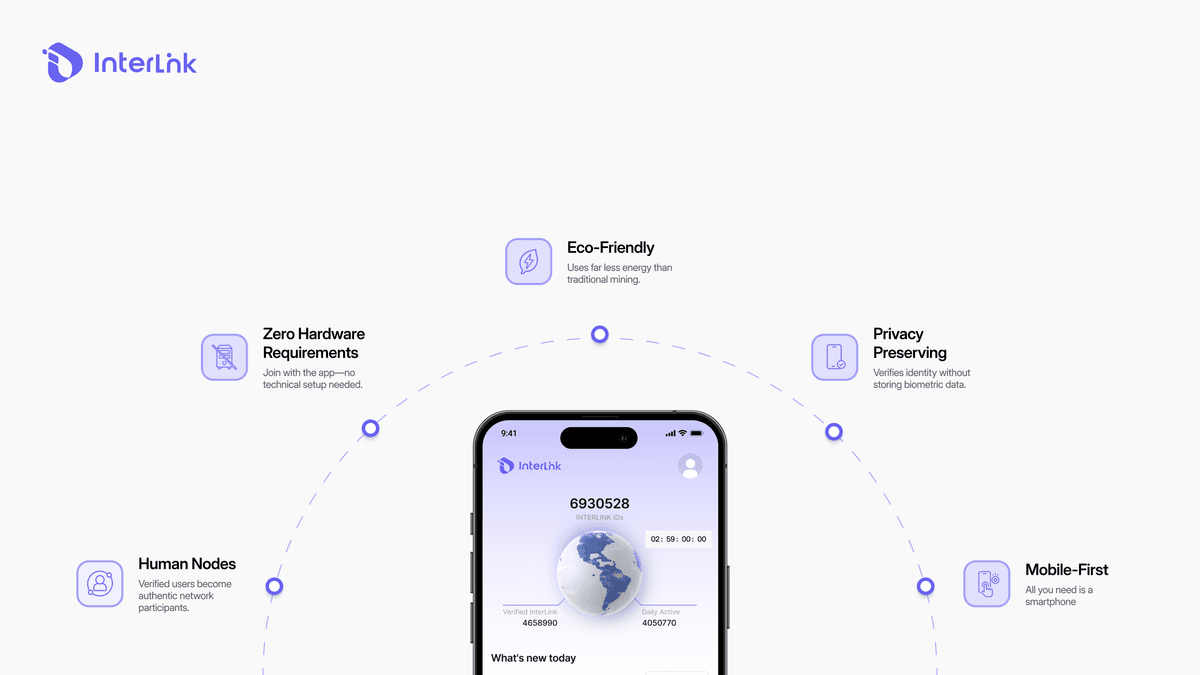
Here's what makes InterLink's approach unique:
Key Concept: DePIN (Decentralized Physical Infrastructure Networks) for Mobile
The InterLink Network is a decentralized infrastructure designed to support a global Human Network. Using face scanning and liveness detection, users verify their identity without exposing personal data, and become Human Nodes that help secure and maintain the integrity of the network.
Each verified user acts as a Human Node, a living, authentic participant in the decentralized ecosystem. By simply being a real human and engaging with the InterLink network, users contribute value and are rewarded fairly.
The system ensures that each user is uniquely identified without compromising privacy, leveraging blockchain-based identity management and cryptographic techniques to prevent Sybil attacks.
How to Contribute to InterLink AI Data Validation Tasks?
InterLink’s AI data validation system uses Unique Data Training, allowing verified human contributors to participate in AI data-related tasks. The process is straightforward and can be completed directly through the InterLink app.
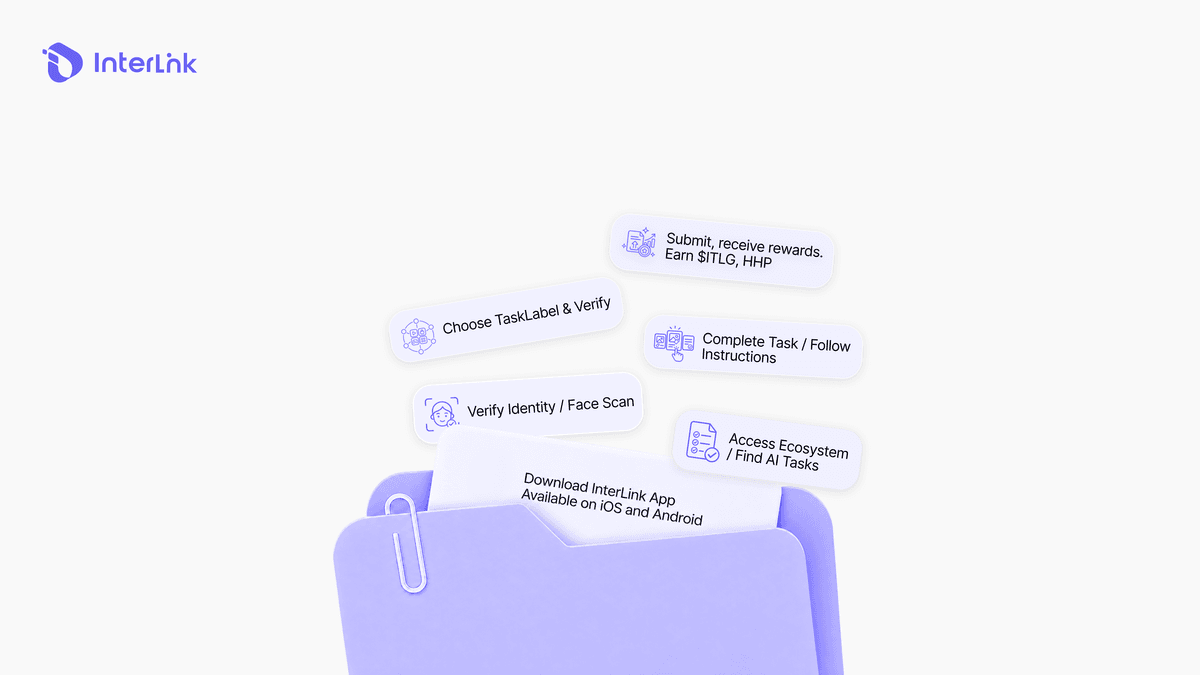
Step 1 - Download the InterLink App: Install the InterLink app from the official iOS or Android app store and create your account.
Step 2 - Complete Identity Verification: Complete the required identity verification process, including a one-time facial scan and liveness check.
Step 3 - Open the Mini App or Ecosystem Section: Navigate to the Mini App or Ecosystem section to find available AI data validation tasks.
Step 4 - Choose a Task: Select an available task based on the instructions provided. Tasks may include image labeling, text verification, or other data contribution activities.
Step 5 - Complete the Task: Follow the on-screen instructions to complete the assigned task. No specialized technical skills are generally required.
Step 6 - Submit Your Work and Earn Rewards: Submit the completed task according to the provided requirements. Eligible contributions can earn $ITLG rewards and may contribute to your Human Hash Power (HHP).
What kind of tasks will you do?
Key Concept: Reinforcement Learning from Human Feedback (RLHF) in Web3
In simple terms, RLHF means AI learns from human feedback. When you complete a task like labeling an image or verifying a text response you're providing real human input that helps train AI models to be more accurate and reliable.
This validation process mitigates the risk of synthetic or fraudulent inputs that could otherwise distort model learning.
Why does your contribution matter?
AI model accuracy is often compromised by data contamination where excessive duplicate and bot-generated inputs degrade learning quality. Conventional AI training methods rely on large-scale, centralized data collection, making them vulnerable to biases, redundancies, and security risks.
By participating in InterLink's data validation tasks, you're helping ensure that AI models learn from unique, bot-free data resulting in algorithms with higher decision accuracy and greater reliability.
Why AI Networks Urgently Need Proof of Personhood in 2026
Here's the problem AI faces right now: AI is being trained on AI-generated content.
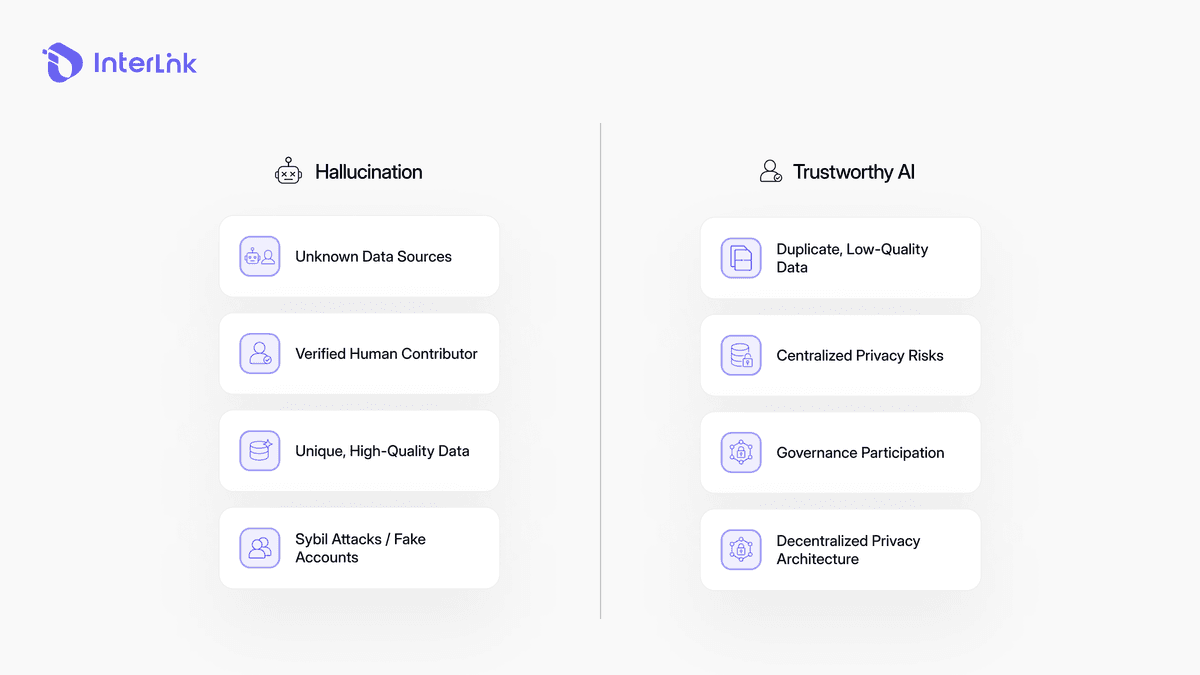
This creates a dangerous feedback loop. When AI models are trained on data that was itself generated by other AI models, the quality of the output degrades over time. This is sometimes called "AI Hallucination" when AI generates confident but completely false information.
The root cause? Bot-generated data flooding the training process. Without a way to verify that data comes from real humans, AI systems can't distinguish between quality human input and low-quality bot output.
This is exactly where InterLink's Proof of Personhood (PoP) comes in.
Proof of Personhood (PoP) is a groundbreaking consensus mechanism that secures the network by ensuring only verified human users can participate
Unlike traditional models such as Proof of Work (which relies on computational power) or Proof of Stake (which depends on token ownership), PoP ties validation directly to real human identities through the InterLink ID.
How does this help AI?
By requiring validators to hold a verified InterLink ID, PoP effectively prevents Sybil attacks where malicious actors attempt to dominate the network with multiple fake identities.
To prevent bot interference and duplicate data submissions, a proof-of-personhood mechanism is implemented. Each participant undergoes identity verification before contributing data, guaranteeing dataset authenticity and uniqueness.
The bottom line: In an age where AI can generate content that looks human but isn't, the ability to verify real human identity is no longer optional, it's essential for building trustworthy AI systems.\
Conclusion
InterLink transforms everyday smartphones into a privacy-preserving, bot-resistant network that rewards real humans for training AI models without requiring expensive hardware. While facial verification is mandatory and reward rates evolve over time, the system effectively solves AI's data contamination crisis.
Backed by a community of over 9 million users and the recent Seoul Mainnet (v6.0.0) launch, InterLink continues to advance its roadmap with expanded AI tasks, mini-dApps, and integrated Visa payment infrastructure.
Important Disclaimer: This article from InterLink Labs is for educational purposes only and does not constitute financial, investment, or legal advice. Crypto assets involve substantial risk, including possible loss of value. Token utility, reward rates, and conversion mechanisms can change. Always conduct your own research (DYOR) and use only official channels.
Want to Learn More? If you're curious about how InterLink's Mobile DePIN architecture works, you can explore the app and see the ecosystem for yourself with no commitment needed.
Need to reset your password? Follow our step-by-step InterLink password recovery guide.

