



What Is A Stablecoin In 2026: How They Work And Why They Matter
Nov 04, 2026
Our journey
Stablecoins are the quiet plumbing of the crypto economy. While Bitcoin is known for price swings, stablecoins are designed to stay still. As of early 2026, the total supply of major stablecoins reached roughly $304 billion, with USDT and USDC alone accounting for about 89% of the market.
This guide explains what a stablecoin is, how they work, their main risks, and how InterLink Labs is using them as the first payment rail inside ITLX Pay. For a broader look at how these digital assets integrate with physical commerce, you can explore our complete InterLink Payments guide.
What Is Stablecoin?
A stablecoin is a blockchain token designed to hold a steady value, usually one US dollar. It solves a practical problem: Bitcoin and other cryptocurrencies are too volatile to serve as everyday money. By offering a dollar that lives on-chain, stablecoins provide a reliable asset for trading, cross-border payments, and DeFi.
The token itself is just a unit on a blockchain. The "peg" is the target value it aims for ($1). The "backing" is whatever stands behind that promise to keep the price at the target.
How Do Stablecoins Work?
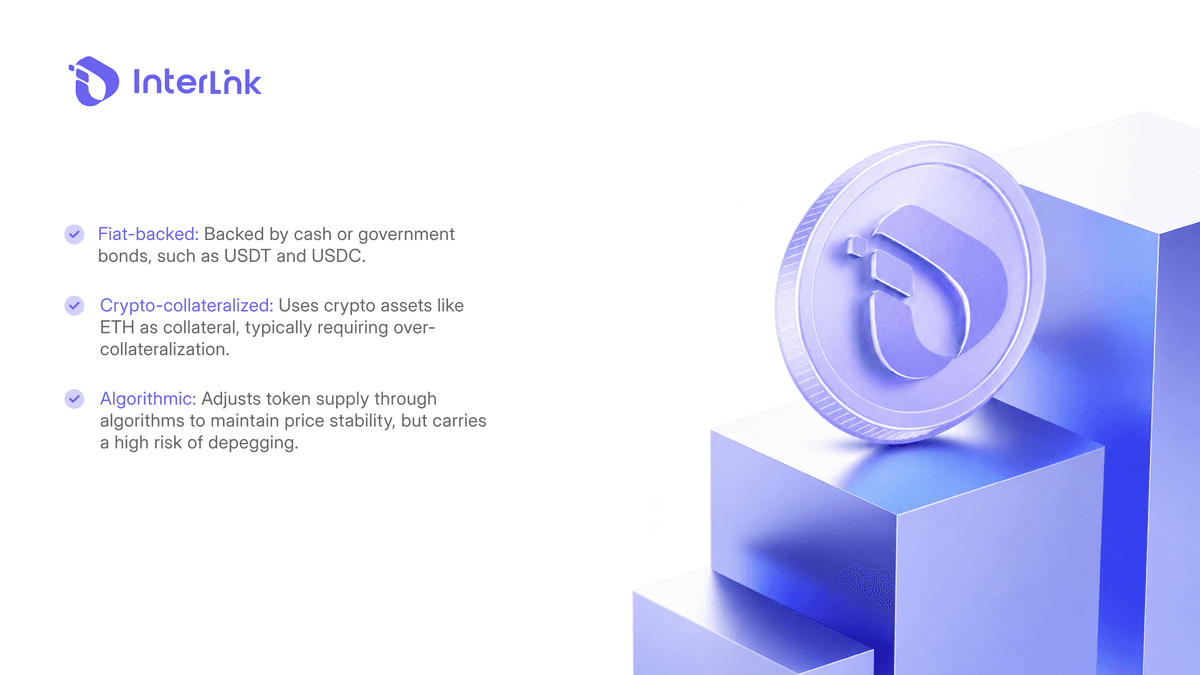
Different stablecoins maintain their peg through different mechanisms:
- Fiat-backed: A user deposits $1 with an issuer and receives 1 stablecoin. The peg holds through arbitrage. If the coin drops to $0.99, traders buy it and redeem it for $1.00, pushing the price back up. This relies entirely on the issuer holding real, liquid reserves.
- Crypto-collateralized: Instead of bank reserves, these are backed by other crypto assets (like ETH). Because crypto is volatile, they are over-collateralized. To mint $100, a user might need to lock up $150 in ETH. If the collateral drops too low, smart contracts automatically liquidate it.
- Algorithmic: These use code to expand or contract supply to maintain the peg, without hard collateral. This model has largely failed at scale (e.g., TerraUSD), and most surviving projects now use hybrid models.
The Main Types of Stablecoins
Stablecoins differ almost entirely in their backing. Here is how the four main models compare:
Stablecoin Risks to Understand
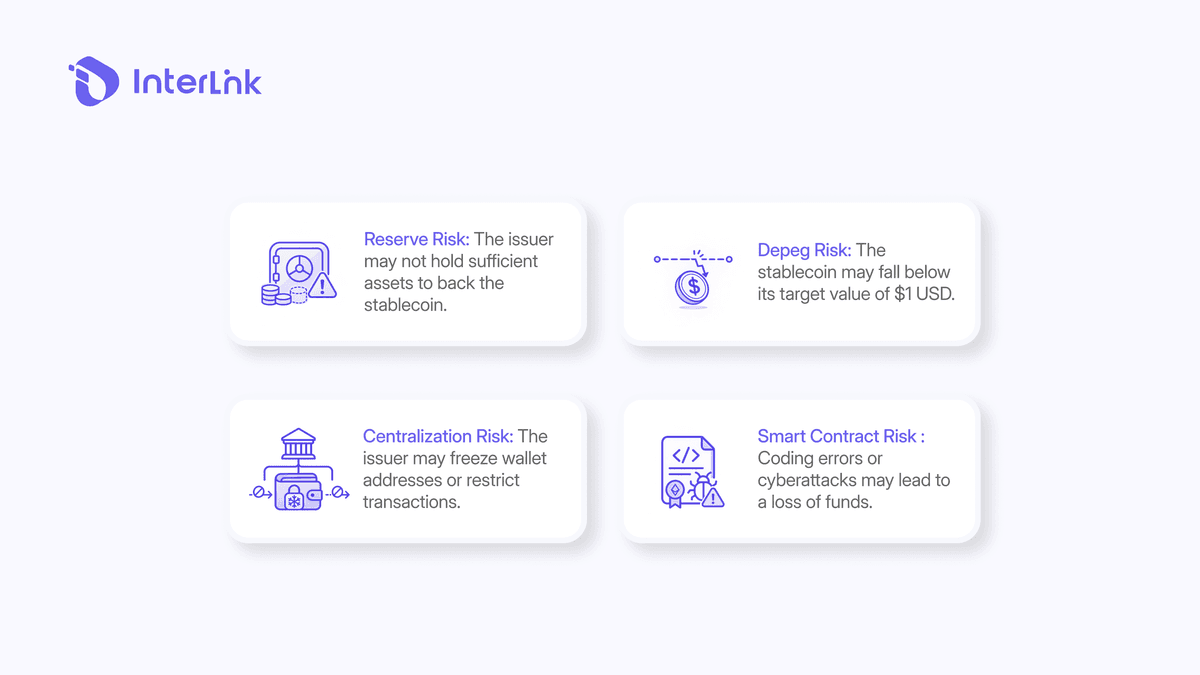
Stability is a promise, not a guarantee. Here are the key risks:
- Reserve Risk: Fiat-backed coins depend on the issuer actually holding the cash they claim to have.
- Depeg Risk: Confidence can break, causing the coin to drop below $1. This can trigger forced selling in DeFi.
- Centralization Risk: Issuers of fiat-backed coins can freeze addresses or block transactions.
- Smart Contract Risk: Crypto-backed coins rely on code, which can be exploited by bugs or hacks.
Stablecoins and InterLink Labs: Real-World Payments via ITLX Pay
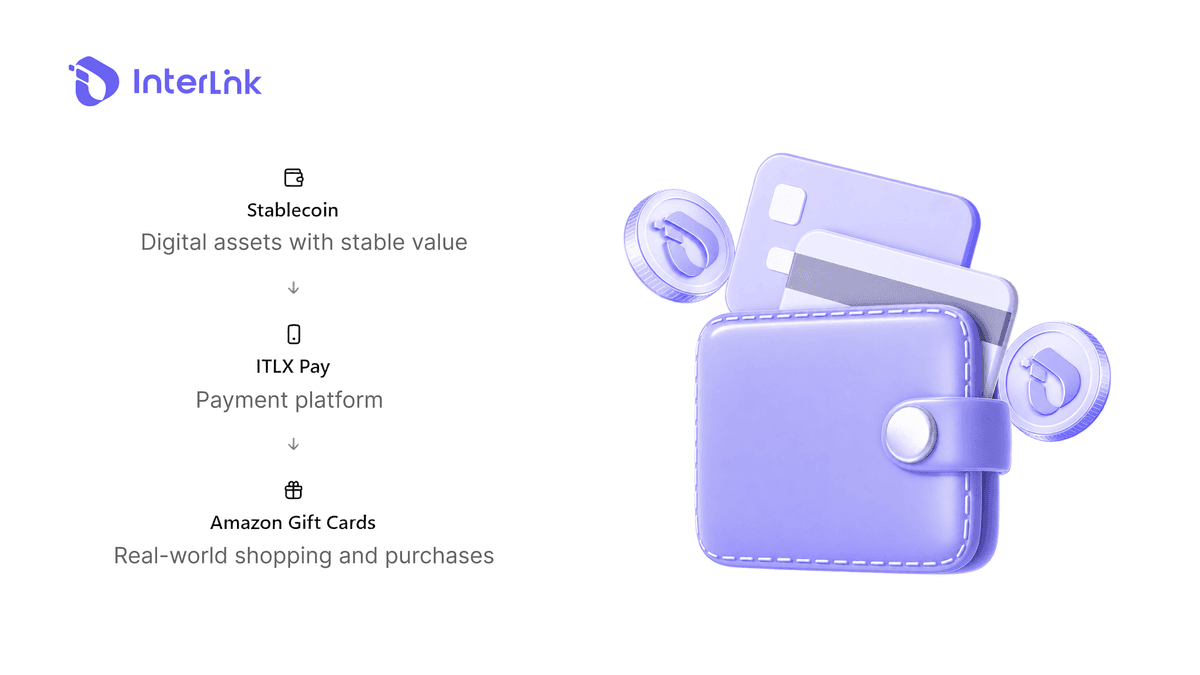
For stablecoins to be truly valuable, they must be spendable. InterLink Labs has made stablecoins the first payment rail inside ITLX Pay. To manage these assets securely, users can utilize the ITLX Wallet, which supports multi-chain assets and payments.
Currently, ITLX Pay allows users to use stablecoins to purchase Amazon Gift Cards and redeem them globally. This removes price risk at the point of sale, acting as a bridge between on-chain assets and real-world commerce.
The roadmap is phased. Stablecoins come first for immediate usability. As the ecosystem matures, $ITL will become the native payment asset inside ITLX Pay, actively turning ITL into a real-world payment currency. This dual-token model ensures that everyday purchases will eventually generate organic demand for the network.
For users who started their Web3 journey via a free crypto app or a free mining app, this integration is the next logical step. It transforms digital tokens into practical spending power for everyday items.
How to Evaluate a Stablecoin
Before using a stablecoin, check these factors:
- Backing: Is the reserve composition transparent and regularly audited?
- Peg History: Has it ever significantly lost its peg during market stress?
- Regulation: Is the issuer compliant with frameworks like MiCA or the GENIUS Act?
- Liquidity: Are there deep markets to easily trade in and out of the coin?
For payments, fiat-backed stablecoins are the most practical due to high liquidity and stability. For DeFi, crypto-collateralized coins offer censorship resistance but carry liquidation risk.
Conclusion
A stablecoin is a blockchain token designed to hold a steady value. Fiat-backed models currently dominate because they offer the highest stability for payments and trading, though risks like depeg and centralization remain. As InterLink Labs demonstrates with ITLX Pay, stablecoins are evolving from simple trading tools into the settlement layer for real-world commerce. If you are moving beyond a free mining app or a free crypto app, understanding stablecoins is the key to using your assets in the broader economy.
Disclaimer: This guide is for educational purposes only and does not constitute financial advice. Always conduct your own research before using any stablecoin.
Related Articles:
Learn how to use InterLink Payments for QR and crypto transactions
Discover the utility of ITL Token in the ecosystem
Explore how ITL is becoming a real-world payment currency
Understand the ITLX Wallet for DeFi and payments

