



What Is DeFi Lending: How It Works, Rates And ITL Vault
Nov 06, 2026
Technology
DeFi lending has become a cornerstone of decentralized finance, with total outstanding loans reaching approximately $20.4 billion by the end of Q2 2026. Unlike traditional banking, DeFi lending allows users to borrow and lend digital assets through smart contracts without intermediaries or credit scores.
This guide explains what DeFi lending is, how it works, current rates in 2026, key risks, and how ITL Vault is bringing a conservative collateralized lending model to everyday users within the broader InterLink ecosystem.
What Is DeFi Lending?
DeFi lending is one of the most practical applications of blockchain, but its mechanics differ completely from traditional banking. Understanding this foundation is the first step before participating in any lending protocol.
Definition and Core Concept
DeFi lending is the process of borrowing and lending digital assets through smart contracts on a blockchain, without banks or central credit institutions. Instead of relying on credit scores or paperwork, loans in DeFi are fully secured by collateral. Borrowers lock their assets into a smart contract, and the value of that collateral must exceed the amount they wish to borrow. This mechanism is called over-collateralization, and it is the foundation of protection for both lenders and the protocol.
How DeFi Lending Works Step by Step
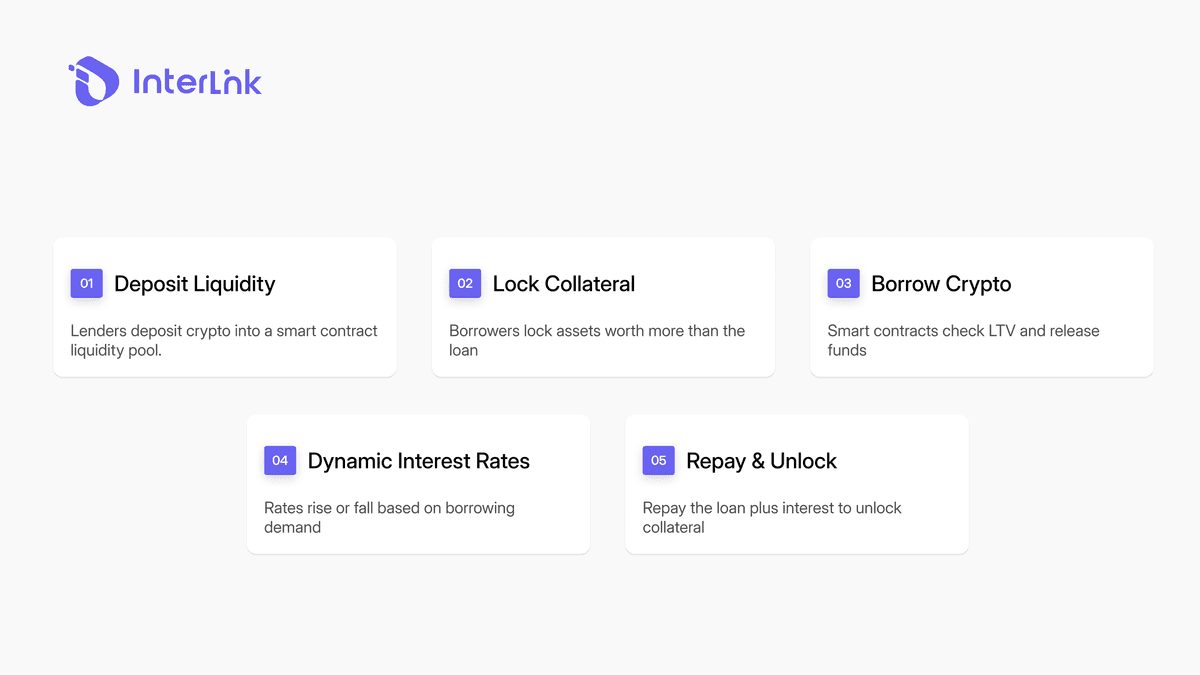
The process follows a clear sequence. First, lenders deposit assets into a liquidity pool managed by a smart contract. A borrower who wants to access those funds must lock collateral worth more than the loan amount. The smart contract automatically calculates the loan-to-value (LTV) ratio and disburses funds if conditions are met. Interest rates are determined by the pool's utilization rate.
When more people borrow, rates rise to encourage more deposits. When borrowing slows, rates fall. When the borrower repays the loan with interest, the collateral is unlocked. To interact with these smart contracts, users typically need a secure non-custodial solution like the ITLX Wallet.
The Role of Smart Contracts and Oracles
Smart contracts are the engine of DeFi lending. They automatically enforce loan terms, calculate interest, and trigger liquidations when necessary without human intervention. However, smart contracts require accurate price data from outside the blockchain to function correctly.
This is the role of oracles such as Chainlink, which feed real-time asset prices on-chain. Without reliable oracles, protocols cannot accurately value collateral and risk wrongful liquidations or exploits.
DeFi Lending Rates in 2026
Interest rates in DeFi lending are not fixed like bank rates. They change continuously based on supply and demand within each liquidity pool. Understanding how they move helps users make better decisions.
How DeFi Lending Rates Are Determined
Rates are set by an algorithmic interest rate model that depends on the pool's utilization rate. When utilization is low, rates stay low to encourage borrowing. When utilization rises, rates increase exponentially to attract more deposits and cool borrowing demand. This mechanism maintains liquidity for the protocol without human intervention.
Average DeFi Lending Rates in 2026
According to Galaxy Research and DefiLlama data, as of Q2 2026, the average stablecoin borrow rate sits at approximately 4.7%, while the average supply rate is around 3.6%. This creates a spread of roughly 1.05 percentage points between the cost of borrowing and the yield for depositors. Actual rates vary significantly depending on the protocol, asset type, and blockchain.
Rates Across Major Lending Protocols
Major protocols offer different rates due to variations in risk models and liquidity. Aave V3, the largest lending protocol with roughly $11.8 billion in active loans, typically offers competitive stablecoin rates. Morpho, with its curated vault architecture, can achieve higher APY for certain assets. Spark and Maple focus on different segments, from retail savings to institutional credit. Users should compare live rates on platforms like DefiLlama before deciding.
Types of DeFi Lending
Not all DeFi lending protocols operate the same way. Different models serve different needs and come with varying levels of risk and complexity.
Pool-Based Lending
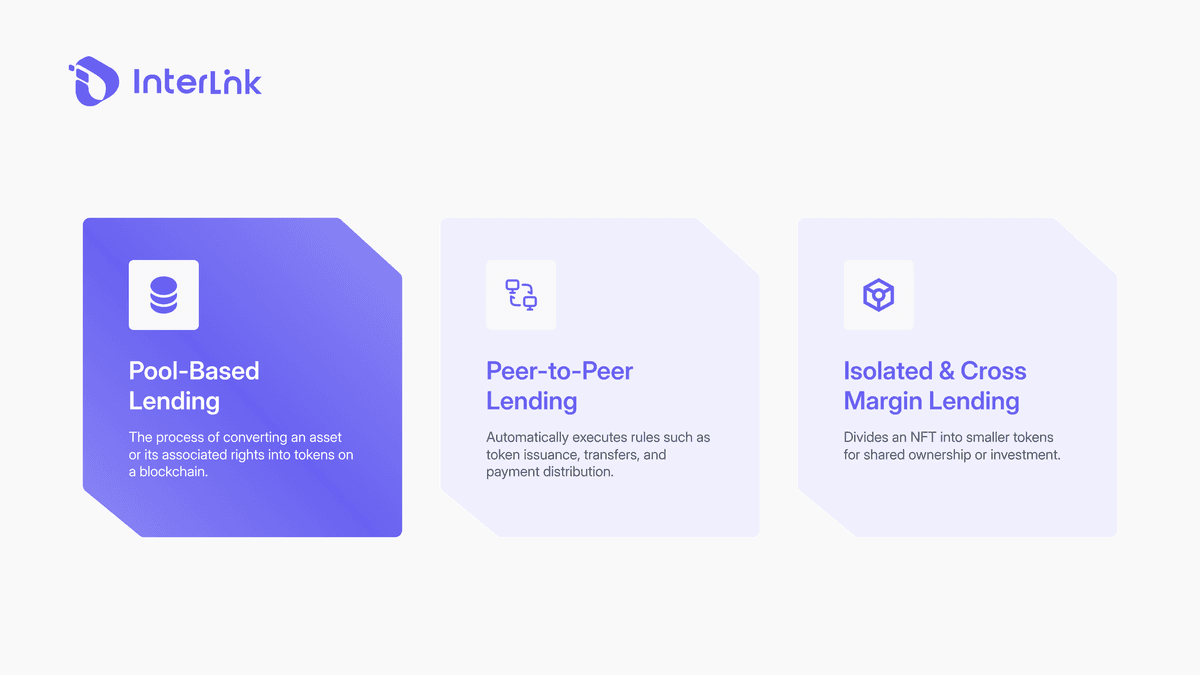
This is the most common model. Lenders deposit assets into a shared pool, and borrowers draw from it. Interest rates are set algorithmically based on utilization. Aave and Compound are prime examples. This model is simple, highly liquid, and suitable for most users.
Peer-to-Peer Lending
In this model, lenders and borrowers are matched directly through smart contracts rather than a shared pool. This allows for more flexible terms, but liquidity is usually lower and matching can take longer. It suits loans with specific durations or less common assets.
Isolated and Cross-Margin Lending
Some protocols separate risk between markets (isolated markets), meaning one collateral asset only secures a specific loan and does not affect other positions. Conversely, cross-margin allows multiple collateral assets to secure a group of positions, but carries higher contagion risk if one asset drops in value.
ITL Vault: Collateralized Lending on InterLink
While traditional DeFi lending protocols require interacting with complex smart contracts, InterLink Labs offers ITL Vault, a streamlined model that still ensures transparency and safety.
How ITL Vault Works
ITL Vault is a collateralized lending protocol built on the InterLink Chain. Users lock ITL tokens as collateral to borrow USDT, with a maximum LTV of 30%. This means to borrow 100 USDT, a user must lock at least $333 worth of ITL. This low LTV reflects a conservative approach, minimizing the risk of sudden liquidations during market volatility. You can read more about the utility of ITL tokens and how they power this mechanism.
Loan Terms and Fees
ITL Vault offers flexible terms of 30, 60, and 90 days, with fixed fees of 1.5%, 3%, and 4.5% respectively, plus a 1% origination fee on the borrowed USDT. This fee structure is transparent and predictable, unlike the floating rates of many other DeFi protocols. Users know the exact cost before opening a loan.
Risk Management and Transparency
ITL Vault applies multiple layers of protection. Collateral is locked on-chain in a smart contract, not transferred to the team's wallet. Every loan request goes through an approval step before disbursement. Initial collateral valuation uses OTC pricing, with plans to integrate decentralized oracles in the future. Positions are monitored continuously, and LTV thresholds are tightly controlled to prevent cascading liquidation risks.
Risks of DeFi Lending
DeFi lending removes intermediaries but does not remove risk. Understanding the following risks helps users protect their capital and make informed decisions.
Smart Contract Risk
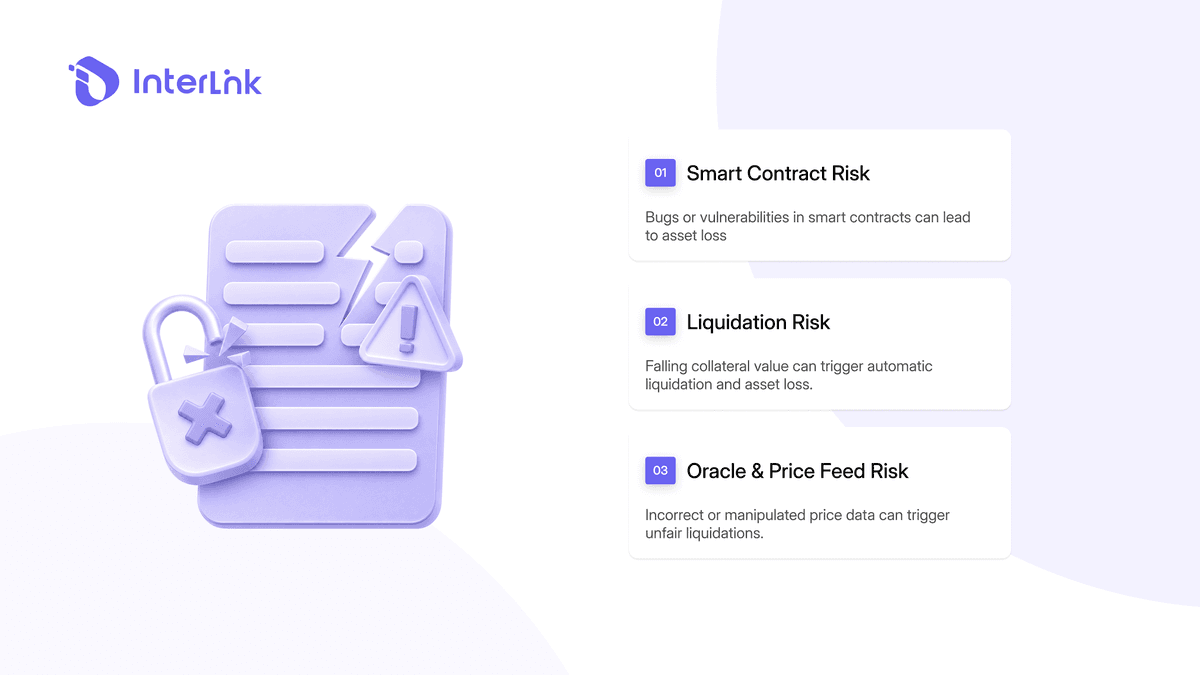
Smart contracts can contain bugs or be exploited, leading to loss of funds. While major protocols like Aave have undergone multiple audits and operated stably for years, the risk is never zero. Users should prioritize protocols with independent audits and long track records.
Liquidation Risk
When collateral value falls below the allowed LTV threshold, a position can be automatically liquidated. The borrower loses part or all of their collateral, often with an additional liquidation fee. This is the most common risk in DeFi lending, highlighting the importance of maintaining a safe LTV ratio, especially during market volatility.
Oracle and Price Feed Risk
If an oracle provides incorrect prices or is attacked, the protocol may liquidate positions unfairly or miss positions that should be liquidated. Protocols use multiple oracle sources and cross-checking mechanisms to mitigate this, but users should still understand the oracle model of the protocol they join.
Conclusion
DeFi lending is one of the most practical applications of blockchain, allowing users to borrow and lend digital assets without banks. With average stablecoin borrow rates around 4.7% and supply rates near 3.6% in 2026, this is a mature market with significant liquidity. However, smart contract, liquidation, and oracle risks remain important factors to evaluate carefully.
ITL Vault offers a more conservative approach with its 30% maximum LTV and fixed terms of 30, 60, and 90 days. For those who entered Web3 through a free crypto app or a free mining app, protocols like ITL Vault demonstrate a clear path to turning digital assets into usable financial tools. Beyond lending, users can also explore earning passive income with crypto through staking and other yield strategies.
Disclaimer: This guide is for educational purposes only and does not constitute financial advice. DeFi lending carries risk, including the potential loss of collateral. Always conduct your own research before participating.
Related Articles:
Understand the full InterLink ecosystem and how all products connect
Learn about the utility of ITL tokens used as collateral in ITL Vault
Set up your secure wallet with our ITLX Wallet guide
Discover other ways of earning passive income with crypto

