



Biometric Identity Verification In Crypto Explained
Oct 20, 2026
Technology
Worried that crypto identity checks mean uploading ID photos and face scans to a company server? Traditional KYC often creates privacy risks. Modern biometric systems aim to prove you are a unique living human without storing raw documents or original face images. This guide explains how biometric identity verification works in crypto and how privacy-preserving Proof of Personhood with Zero-Knowledge Proofs changes the model.
What Is Biometric Identity Verification in Crypto?
Biometric identity verification uses unique human traits such as face patterns to confirm that an account belongs to a real person. In crypto, the goal is practical: reduce bots, fake accounts, and Sybil attacks so rewards, access, and governance can favor real humans.
There are two broad approaches:
- Traditional KYC-style biometrics: capture face and documents, then store or process them through centralized providers
- Privacy-preserving Proof of Personhood: verify uniqueness with on-device processing and cryptographic proof, while minimizing raw data exposure
Key Concept: Proof of Personhood
Proof of Personhood aims to prove that an account is controlled by one unique living human without necessarily revealing who that person is in full legal detail.
The Privacy Problem with Traditional KYC
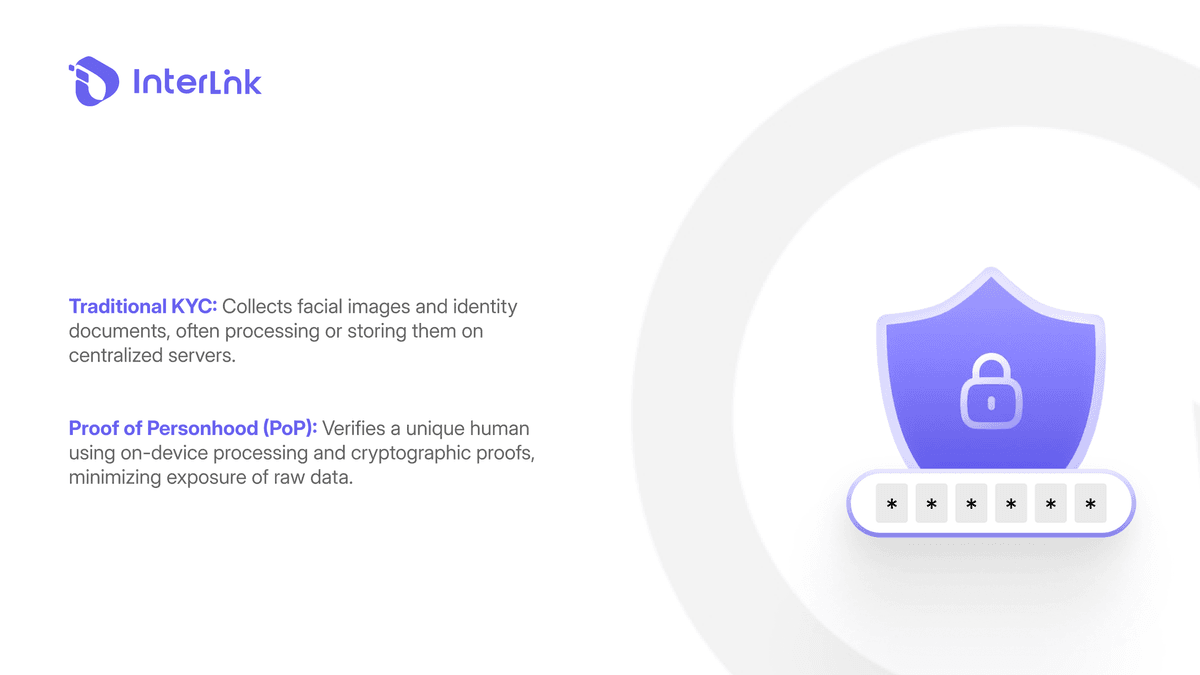
Traditional KYC solves identity checks, but often creates a new risk: centralized storage of sensitive personal data. Users typically submit ID photos, passports, and selfies to company servers or third-party providers. That model can work for compliance, but it concentrates high-value personal data in databases that may later be breached or misused.
In Web3, this creates a clear tension: many networks aim to be open and decentralized, yet still depend on centralized identity databases for anti-fraud checks.
Key Concept: Centralized Identity Risk
When many platforms store copies of your ID and face, one breach can expose the same sensitive data across multiple services.
How Biometric Identity Works in Privacy-Preserving Crypto Systems
Privacy-preserving biometric systems try to verify uniqueness without turning your face into a stored identity file. A typical flow looks like this:
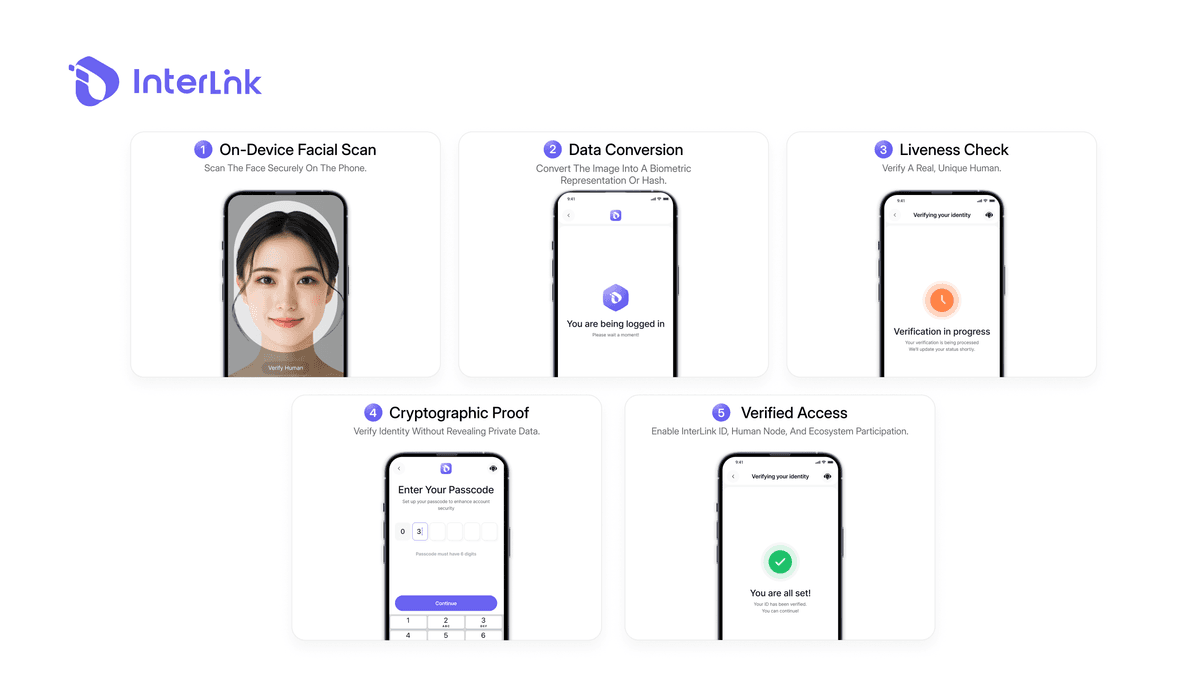
- Step 1: Your face is scanned on your own phone. The entire process happens inside your phone's secure hardware. This is called Secure Enclave on iOS devices and TrustZone on Android devices. These are dedicated security chips designed to process sensitive data safely and in isolation from the main operating system.
- Step 2: The raw image is converted into a biometric representation or encrypted hash. The system is designed so verification does not require keeping the original photo. The hash is a non-reversible representation, it cannot be used to reconstruct the original image.
- Step 3: The system checks that the scan comes from a live person and evaluates uniqueness against the network's anti-Sybil design. This step ensures that a photo or pre-recorded video cannot be used to bypass verification.
- Step 4: A cryptographic proof is generated to confirm a valid uniqueness claim, without revealing the underlying face data or full personal identity. Only the mathematical proof is used; the real face data stays private on your device.
- Step 5: Once complete, the user receives a verified credential for network participation. In InterLink's model, this supports InterLink ID and Human Node access for mining, apps, and ecosystem activity.
Key Concept: Zero-Knowledge Proofs (ZKP)
A Zero-Knowledge Proof lets you prove a statement is true without revealing the underlying private data used to prove it. In InterLink's case, the statement is: "This is a unique, living human who has not previously registered." The proof confirms this without revealing your actual face, personal information, or identity.
On-Device Processing vs Centralized Cloud Storage
Where your biometric data is processed is one of the most important privacy decisions in any identity system.
InterLink’s Proof of Personhood flow is designed around the second model: local capture, conversion into a non-reversible representation, and verification through privacy-preserving proof. The result is a verified Human Node identity that can participate without turning every signup into a document submission to a third party.
Why Crypto Needs Biometric Identity
Crypto systems that reward participation need a way to keep bots from overwhelming real users. Without strong uniqueness checks, open reward systems are easy to farm with fake accounts. Biometric Proof of Personhood helps networks:
- Reduce Sybil attacks and bot farms
- Distribute rewards more fairly to real Human Nodes
- Protect governance from spam voting
- Keep the network open to real people without abandoning verification
This is especially important for mobile-first networks where participation is meant to be easy, free, and accessible on a normal smartphone.
Benefits and Limits of Biometric Identity in Crypto
Biometric identity can improve privacy and fairness, but it is not magic.
Potential benefits
- Less need to submit ID documents to multiple third parties
- Less reliance on centralized stores of raw face images
- Stronger proof that an account belongs to a real human
- Fast verification flow on a smartphone
Important limits
- Results still depend on camera quality, lighting, and user setup
- Users must trust the security design of the official app and protocol
- Privacy-preserving PoP does not automatically replace every legal KYC requirement in every context
- Users should only complete verification through official channels
Conclusion
Biometric identity verification in crypto is moving from document-heavy KYC toward privacy-preserving Proof of Personhood. The goal is simple: confirm a unique living human while minimizing raw personal data exposure.
On-device processing and Zero-Knowledge Proofs turn biometric input into cryptographic proof instead of another centralized archive of faces. Identity checks can support network security without requiring users to surrender more personal data than necessary.
Disclaimer: This guide from InterLink Labs is for educational purposes only and does not constitute legal, security, or financial advice. Always verify through official apps and channels. Never share raw ID documents or recovery information with unofficial parties.

